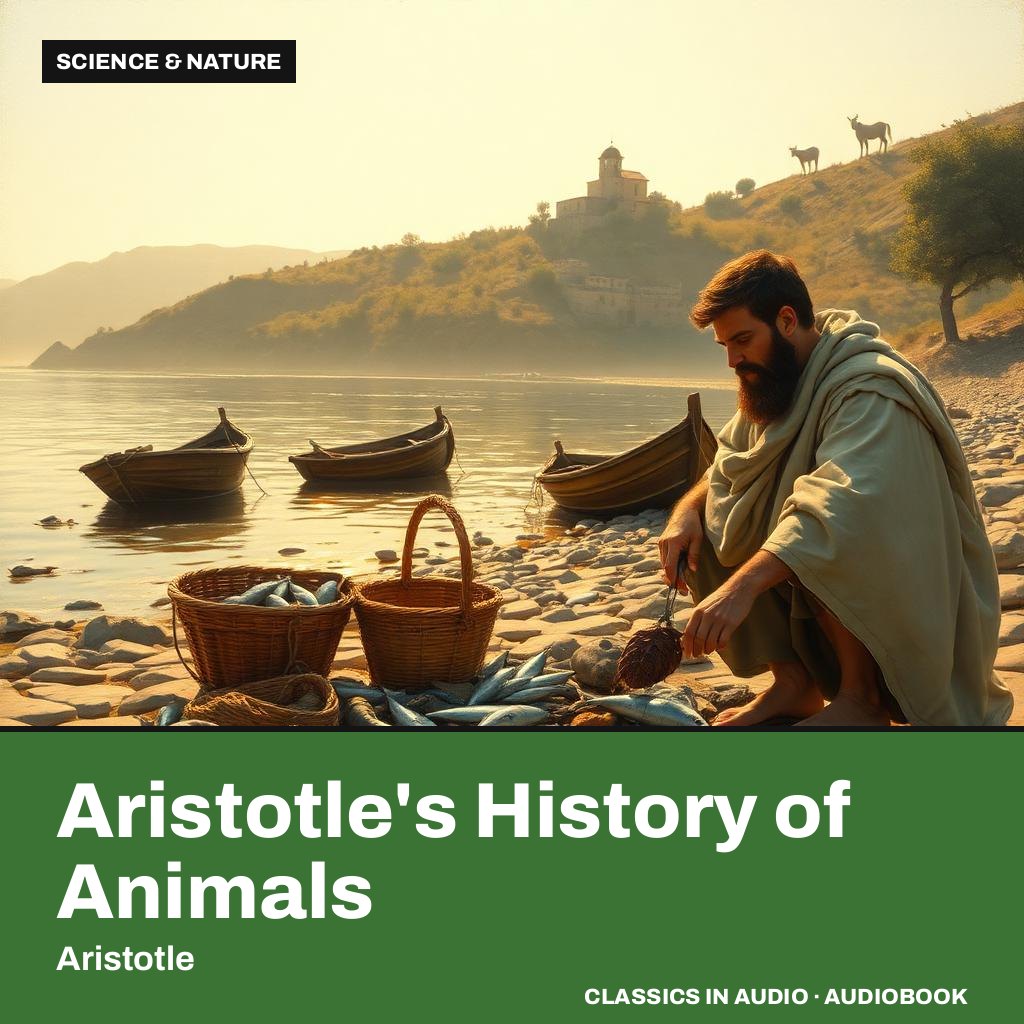
Aristotle's History of Animals
In Ten Books
by Aristotle (384 BC–322 BC)
Unabridged audiobook · about 12 hr 16 min · English · read by a synthetic voice · MP3, no DRM
€5.90
Buy 2 audiobooks or more: −10%. Buy 5 or more: −20%.
Secure payment by Stripe. Your download link is e-mailed to you at once: the first 30 minutes are usually ready within a few minutes, and the rest follows while you listen. Listen online or download the MP3.
Aristotle's History of Animals is the oldest surviving large-scale study of the animal kingdom, a systematic survey of what living creatures are, how they are built, and how they live. It moves through the parts of the body, the ways animals reproduce, their diets, habitats, seasons and temperaments, comparing quadrupeds, birds, fish, insects and the soft-bodied sea creatures such as octopus and cuttlefish. Humans are treated as one animal among others. The setting is the Greek world of the fourth century B.C., its farms, fishing grounds, markets and sacrificial altars, with occasional cautious reports from farther east.
Aristotle, the Athenian philosopher who tutored the young Alexander of Macedon, was working from his own observation as well as the writings of earlier thinkers, and he often names them in order to correct them. He is careful to separate what he has seen from what he has only heard. Some of his claims were later overturned, and others, such as his detailed account of the development of the chick in the egg, held up well.
This edition is Richard Cresswell's nineteenth-century English translation, with notes drawing on Johann Gottlob Schneider's scholarship and an index that tries to identify the many species named. It suits listeners who enjoy seeing how scientific inquiry first took shape.
Text: Project Gutenberg edition no. 59058, read without its licence notices.
More by Aristotle
 The Nicomachean Ethics of AristotleAristotle10 hr 16 min€5.90
 PoliticsAristotle9 hr 27 min€4.90
 The Athenian ConstitutionAristotle2 hr 20 min€3.90
More science & nature
 Body-build and Its InheritanceCharles Benedict Davenport7 hr 56 min€4.90
 On the Origin of Species By Means of Natural SelectionCharles Darwin15 hr 22 min€6.90
 The Interpretation of DreamsSigmund Freud20 hr 00 min€6.90
 The Origin of Species by Means of Natural SelectionCharles Darwin20 hr 41 min€7.90
 Novum OrganumFrancis Bacon8 hr 50 min€4.90
 The Magic of Jewels and CharmsGeorge Frederick Kunz13 hr 31 min€5.90