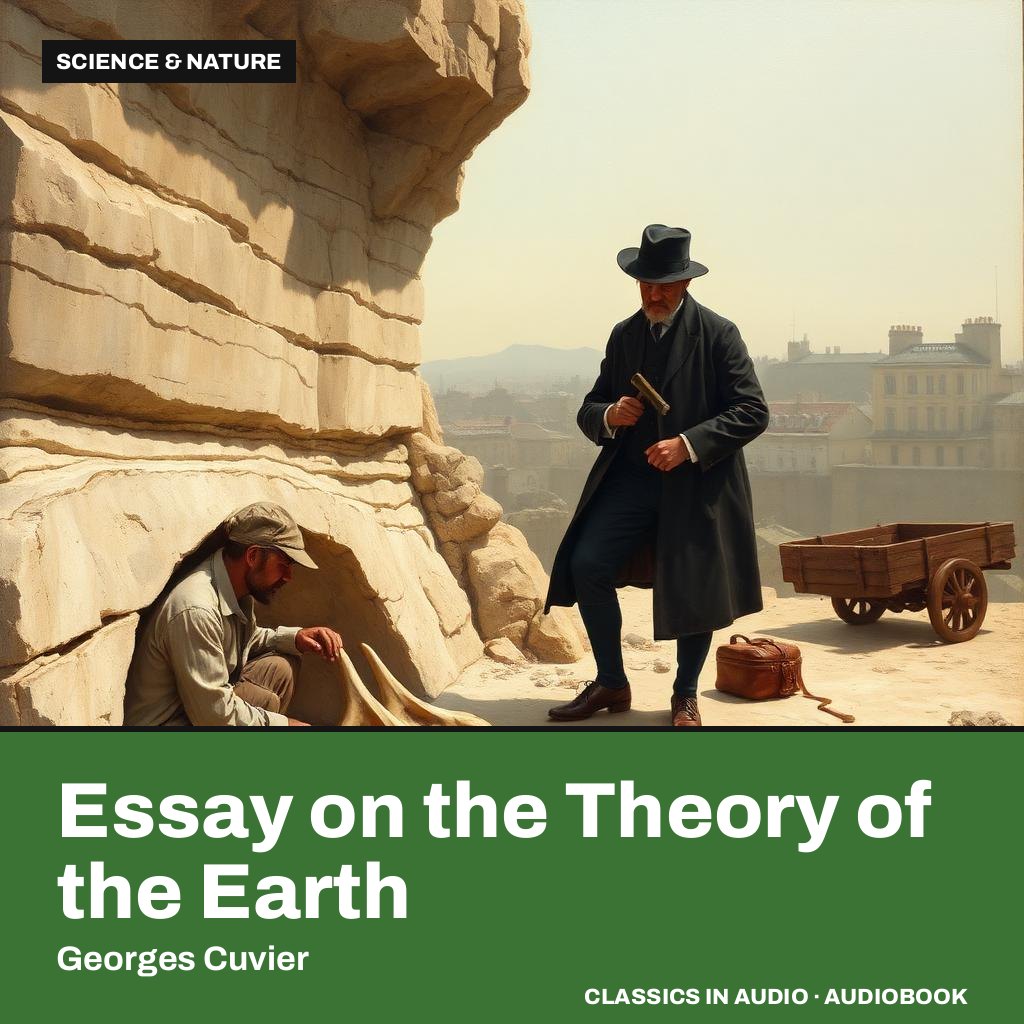
Essay on the Theory of the Earth
by Georges Cuvier (1769–1832)
Unabridged audiobook · about 13 hr 23 min · English · read by a synthetic voice · MP3, no DRM
€5.90
Buy 2 audiobooks or more: −10%. Buy 5 or more: −20%.
Secure payment by Stripe. Your download link is e-mailed to you at once: the first 30 minutes are usually ready within a few minutes, and the rest follows while you listen. Listen online or download the MP3.
Georges Cuvier's Essay on the Theory of the Earth began as the preliminary discourse to his studies of fossil quadrupeds. It argues that the rocks beneath our feet hold a readable history, and that the bones found in them belong to animals no longer alive. Working from the quarries around Paris, Cuvier compares fossil skeletons with living anatomy and concludes that whole species have vanished. He explains this by sudden, violent upheavals in the earth's past. The question of extinction, which many of his contemporaries still resisted, is placed at the centre of the discussion.
The book belongs to the early nineteenth century, when geology was winning recognition as a serious science. Cuvier was a French naturalist and a founder of comparative anatomy and vertebrate palaeontology. This edition is the English translation prepared by the Edinburgh naturalist Robert Jameson, who adds prefaces tracing how the study of fossils spread from Leibniz through the learned societies of Britain and the Continent. It also includes Cuvier's discussions of whether the written records and monuments of ancient nations can show the world to be older than the evidence of the strata suggests.
Today it is worth hearing as a record of how scientific ideas are built: careful observation, bold inference, and arguments that later geologists would revise. Its confident prose shows the moment when the deep past first came into view.
Text: Project Gutenberg edition no. 62918, read without its licence notices.
More science & nature
 Body-build and Its InheritanceCharles Benedict Davenport7 hr 56 min€4.90
 On the Origin of Species By Means of Natural SelectionCharles Darwin15 hr 22 min€6.90
 The Interpretation of DreamsSigmund Freud20 hr 00 min€6.90
 The Origin of Species by Means of Natural SelectionCharles Darwin20 hr 41 min€7.90
 Novum OrganumFrancis Bacon8 hr 50 min€4.90
 The Magic of Jewels and CharmsGeorge Frederick Kunz13 hr 31 min€5.90