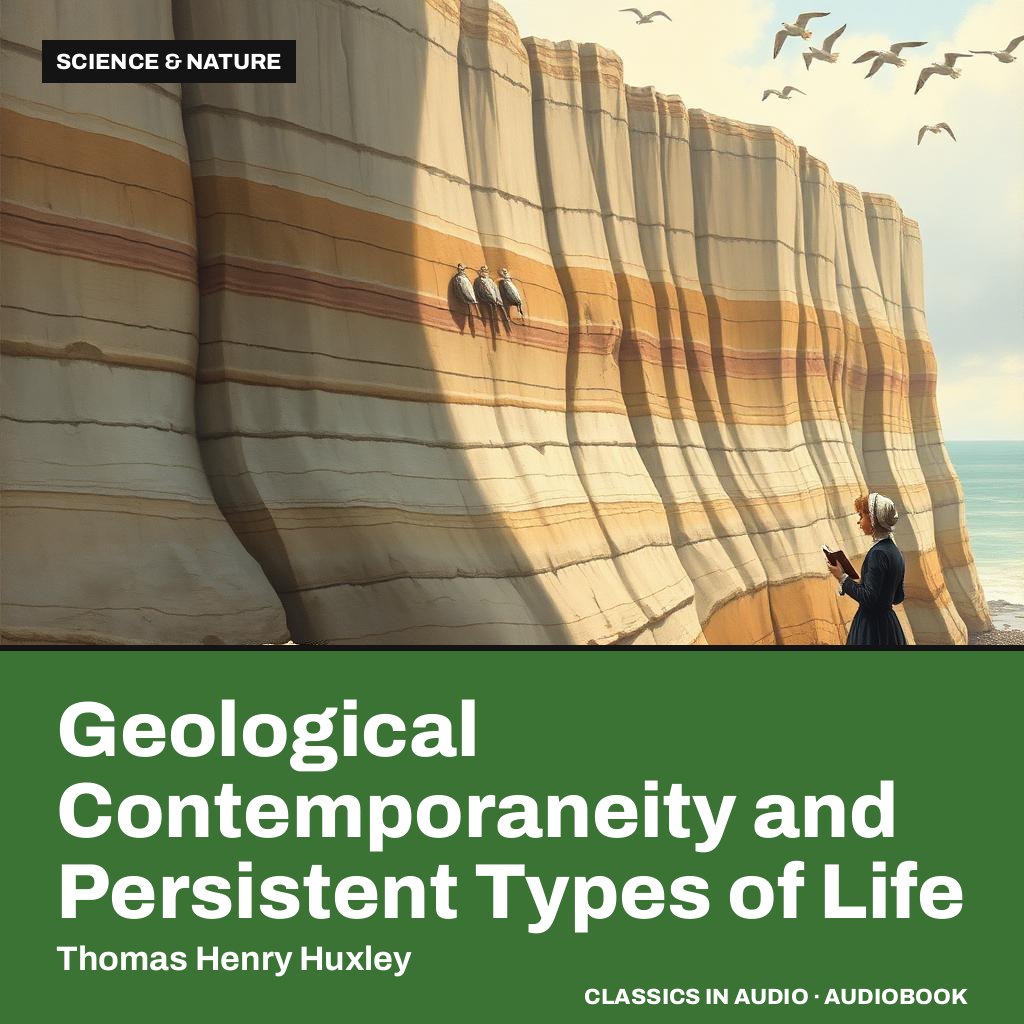
Geological Contemporaneity and Persistent Types of Life
by Thomas Henry Huxley (1825–1895)
Unabridged audiobook · about 44 min · English · read by a synthetic voice · MP3, no DRM
€3.90
Buy 2 audiobooks or more: −10%. Buy 5 or more: −20%.
Secure payment by Stripe. Your download link is e-mailed to you at once: the first 30 minutes are usually ready within a few minutes, and the rest follows while you listen. Listen online or download the MP3.
This is a scientific address delivered in 1862, when the study of fossils was reshaping what people knew about the history of life. Thomas Henry Huxley, the English biologist and anatomist who became Darwin's most combative public defender, takes stock of what palaeontology has actually proved and what it only claims to have proved.
He begins with the solid gains: nearly 40,000 fossil species added to the catalogue of nature, a living population he compares to that of a new continent. He then names two laws established by fossils and rock layers: that the same region of the earth has been occupied in turn by very different creatures, and that the order of succession in one place broadly holds in others. From there he turns to a single word. Rock series in distant places may correspond in order, but does that make them the same age? Huxley proposes the term "homotaxis" for similarity of arrangement, to keep the idea of time out of it.
The argument is a lesson in how scientists test their own conclusions. It also shows the state of geology and evolutionary debate just after the Origin of Species, in the clear, forceful prose of a man who enjoyed a fight over evidence.
Text: Project Gutenberg edition no. 2936, read without its licence notices.
More by Thomas Henry Huxley
 Evidence as to Man's Place in NatureThomas Henry Huxley1 hr 38 min€3.90
 Evolution and Ethics, and Other EssaysThomas Henry Huxley9 hr 22 min€4.90
 Lay Sermons, Addresses and ReviewsThomas Henry Huxley10 hr 25 min€5.90
 Science and Culture, and Other EssaysThomas Henry Huxley9 hr 02 min€4.90
 Man's Place in Nature, and Other EssaysThomas Henry Huxley12 hr 42 min€5.90
 Autobiography and Selected EssaysThomas Henry Huxley5 hr 10 min€4.90
More science & nature
 Body-build and Its InheritanceCharles Benedict Davenport7 hr 56 min€4.90
 On the Origin of Species By Means of Natural SelectionCharles Darwin15 hr 22 min€6.90
 The Interpretation of DreamsSigmund Freud20 hr 00 min€6.90
 The Origin of Species by Means of Natural SelectionCharles Darwin20 hr 41 min€7.90
 Novum OrganumFrancis Bacon8 hr 50 min€4.90
 The Magic of Jewels and CharmsGeorge Frederick Kunz13 hr 31 min€5.90