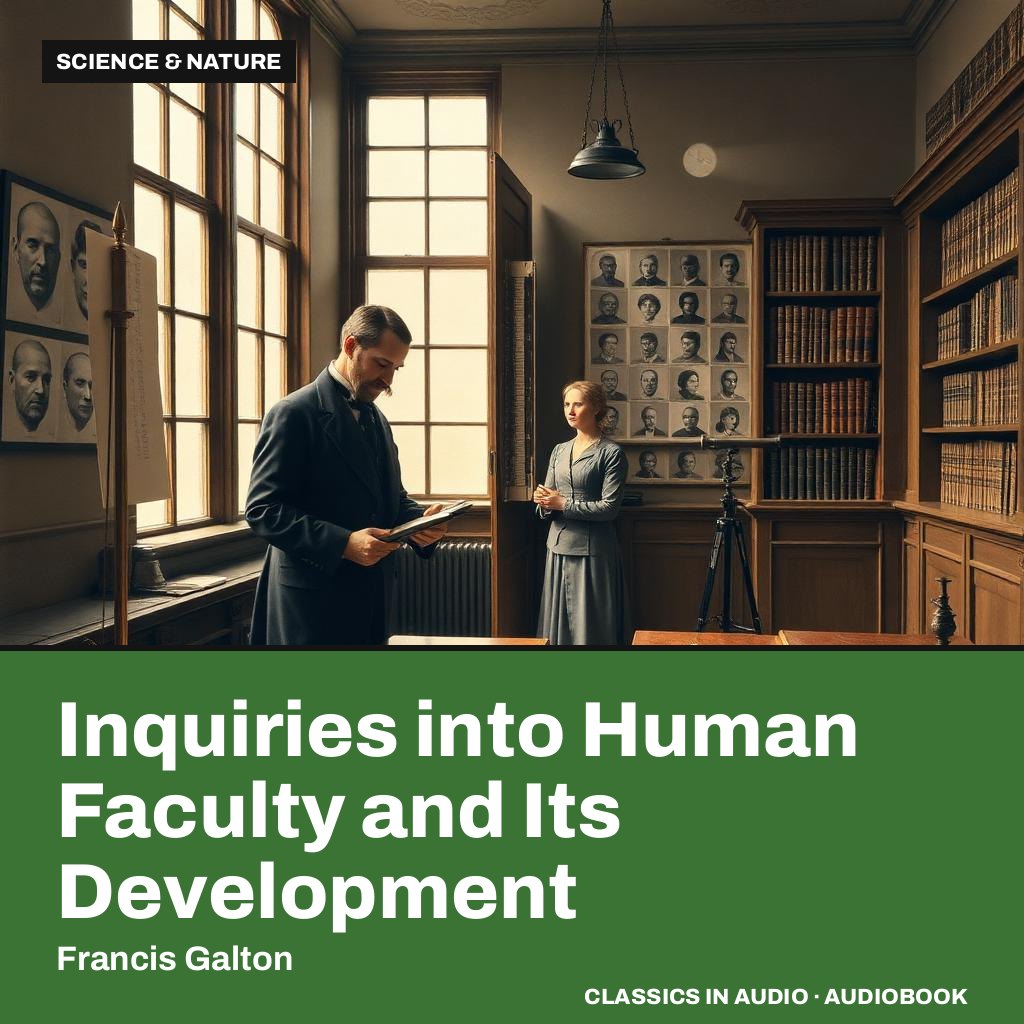
Inquiries into Human Faculty and Its Development
by Francis Galton (1822–1911)
Unabridged audiobook · about 10 hr 01 min · English · read by a synthetic voice · MP3, no DRM
€5.90
Buy 2 audiobooks or more: −10%. Buy 5 or more: −20%.
Secure payment by Stripe. Your download link is e-mailed to you at once: the first 30 minutes are usually ready within a few minutes, and the rest follows while you listen. Listen online or download the MP3.
Inquiries into Human Faculty and its Development, first published in 1883, is a collection of essays in which Francis Galton tries to measure what people are like: how sharply they see and hear, how vividly they picture things in the mind, how far character and talent pass from parent to child. Galton, a cousin of Charles Darwin who had earlier made his name as an explorer in southwest Africa and as a mapper of weather, brought the same appetite for counting to the human mind.
The chapters range widely. He compares twins to separate the effects of upbringing from inheritance, reports on people who see numbers arranged in fixed patterns, and surveys the mental imagery of ordinary, healthy minds. He blends photographs of many faces into single composite portraits, and he builds whistles and other devices to test the limits of the senses. Some of his statistical methods later became standard tools of research.
The book is also where Galton set out the ideas behind eugenics, a movement he named and promoted. Readers today will find sharp observation and real inventiveness alongside opinions about heredity and society that history has judged harshly. It is a revealing record of Victorian science at work, and of how a powerful idea began.
Text: Project Gutenberg edition no. 11562, read without its licence notices.
More by Francis Galton

More science & nature
 Body-build and Its InheritanceCharles Benedict Davenport7 hr 56 min€4.90
 On the Origin of Species By Means of Natural SelectionCharles Darwin15 hr 22 min€6.90
 The Interpretation of DreamsSigmund Freud20 hr 00 min€6.90
 The Origin of Species by Means of Natural SelectionCharles Darwin20 hr 41 min€7.90
 Novum OrganumFrancis Bacon8 hr 50 min€4.90
 The Magic of Jewels and CharmsGeorge Frederick Kunz13 hr 31 min€5.90