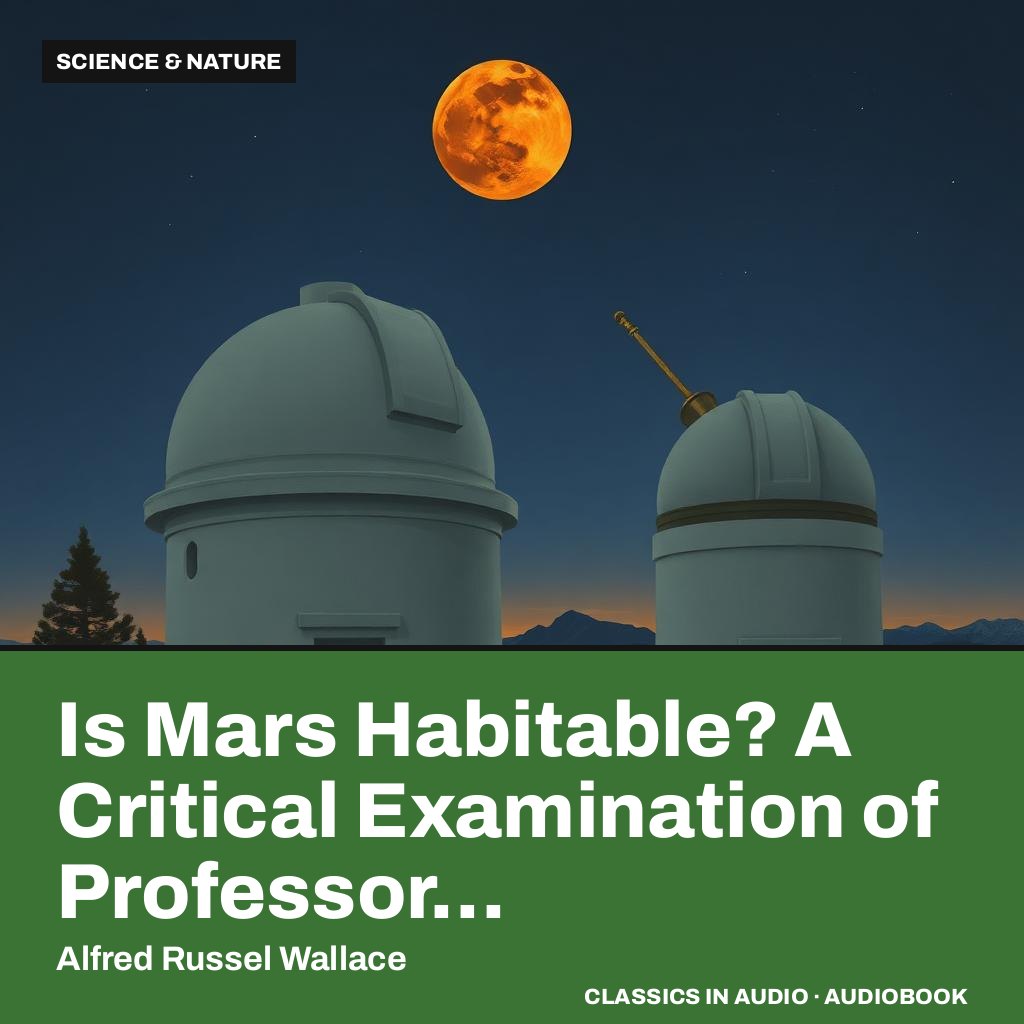
Is Mars Habitable? A Critical Examination of Professor Percival Lowell's Book "Mars and Its Canals," with an Alternative Explanation
by Alfred Russel Wallace (1823–1913)
Unabridged audiobook · about 2 hr 30 min · English · read by a synthetic voice · MP3, no DRM
€3.90
Buy 2 audiobooks or more: −10%. Buy 5 or more: −20%.
Secure payment by Stripe. Your download link is e-mailed to you at once: the first 30 minutes are usually ready within a few minutes, and the rest follows while you listen. Listen online or download the MP3.
In 1906 the American astronomer Percival Lowell published Mars and its canals, arguing that the fine dark lines seen on the red planet were irrigation works built by an intelligent people trying to survive on a drying world. Alfred Russel Wallace, then in his eighties, answered with this short book, written in Dorset and dated October 1907. It is a point-by-point rebuttal of Lowell's claims, and it asks a plain question: could anything like us live there at all?
Wallace was the naturalist who reached the theory of natural selection independently of Darwin, and he brings a field scientist's habits to astronomy. He goes through the early observations from Schiaparelli onward, then tests Lowell's case on water, air and temperature. Lowell had claimed a mild climate for Mars. Wallace disputes this with evidence from the cold of the moon, from the loss of heat in thin air, and from the snow found on high mountains close to the equator. In the last chapters he offers his own account of the canals, drawn from the meteoritic hypothesis and from familiar geology.
The book is a clear record of a famous scientific quarrel, fought when the best telescopes could only hint at what lay on Mars. It also shows how a good argument is built and how a bold idea gets tested against physical fact.
Text: Project Gutenberg edition no. 10855, read without its licence notices.
More by Alfred Russel Wallace
 Contributions to the Theory of Natural SelectionAlfred Russel Wallace10 hr 04 min€5.90
 Darwinism (1889)Alfred Russel Wallace17 hr 43 min€6.90
 Island LifeAlfred Russel Wallace14 hr 42 min€5.90
 Travels on the AmazonAlfred Russel Wallace13 hr 54 min€5.90
 A Narrative of Travels on the Amazon and Rio NegroAlfred Russel Wallace14 hr 32 min€5.90
 Social Environment and Moral ProgressAlfred Russel Wallace2 hr 58 min€3.90
More science & nature
 Body-build and Its InheritanceCharles Benedict Davenport7 hr 56 min€4.90
 On the Origin of Species By Means of Natural SelectionCharles Darwin15 hr 22 min€6.90
 The Interpretation of DreamsSigmund Freud20 hr 00 min€6.90
 The Origin of Species by Means of Natural SelectionCharles Darwin20 hr 41 min€7.90
 Novum OrganumFrancis Bacon8 hr 50 min€4.90
 The Magic of Jewels and CharmsGeorge Frederick Kunz13 hr 31 min€5.90