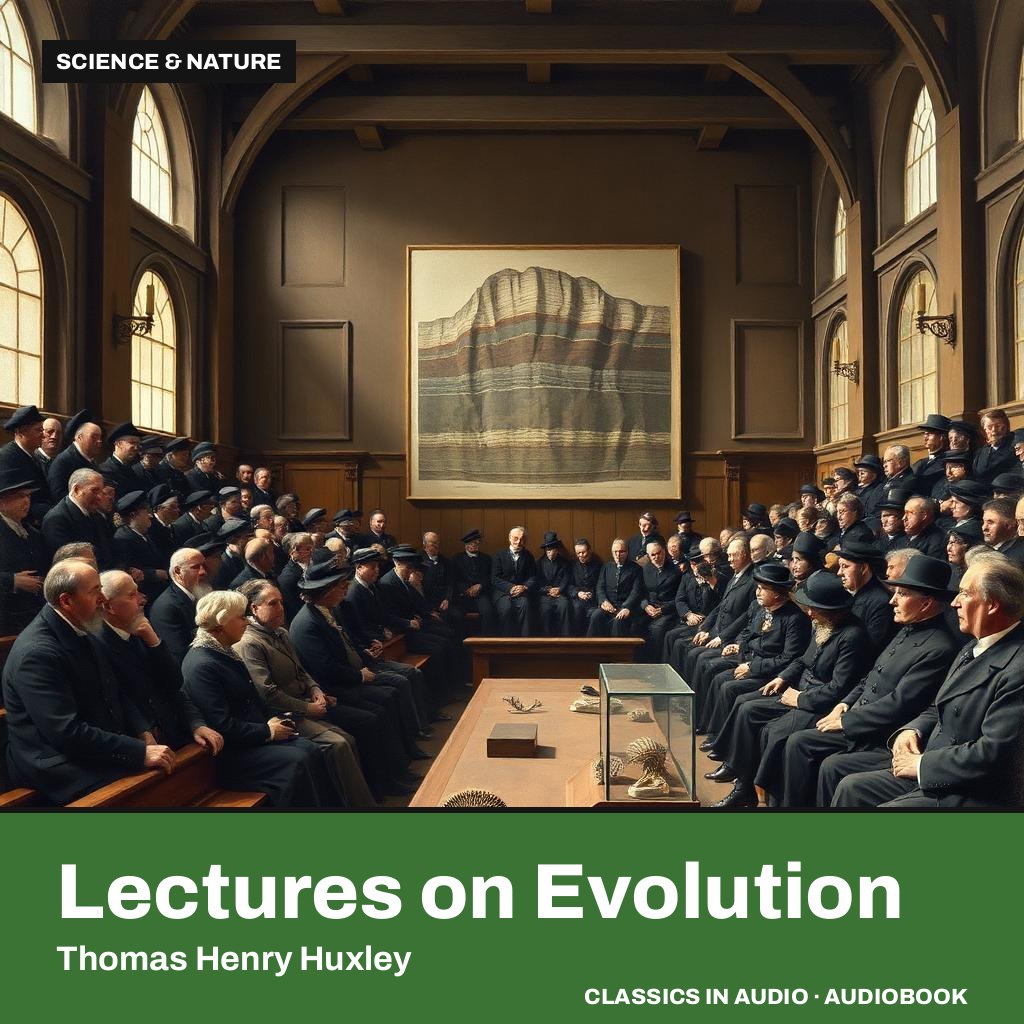
Lectures on Evolution
Essay #3 from "Science and Hebrew Tradition"
by Thomas Henry Huxley (1825–1895)
Unabridged audiobook · about 1 hr 58 min · English · read by a synthetic voice · MP3, no DRM
€3.90
Buy 2 audiobooks or more: −10%. Buy 5 or more: −20%.
Secure payment by Stripe. Your download link is e-mailed to you at once: the first 30 minutes are usually ready within a few minutes, and the rest follows while you listen. Listen online or download the MP3.
This is the opening lecture of Thomas Henry Huxley's three-part series on evolution, given in the 1870s and later gathered with his essays on science and the Bible. It is a work of scientific argument aimed at a general audience, and it begins not with fossils or finches but with a question about method: how do we know what happened in the deep past?
Huxley starts by describing the modern conviction that nature follows a constant order, then admits that even our firmest beliefs are only highly probable. From there he sets out the three hypotheses he thinks can be entertained about the history of the world: that it has always been much as it is now, that it began in its present state without any natural precursor, or that it has developed by natural stages from earlier conditions. He asks what a spectator placed far back in time would actually see under each of them, and he brings in the geologists Hutton and Lyell and their doctrine of uniform change.
Huxley was a London-trained surgeon and anatomist who became Darwin's most combative public defender. Here he is patient and exact, treating the age of the earth as a historical problem to be settled by evidence. Listeners will hear how a Victorian scientist built a case step by step.
Text: Project Gutenberg edition no. 2629, read without its licence notices.
More by Thomas Henry Huxley
 Evidence as to Man's Place in NatureThomas Henry Huxley1 hr 38 min€3.90
 Evolution and Ethics, and Other EssaysThomas Henry Huxley9 hr 22 min€4.90
 Lay Sermons, Addresses and ReviewsThomas Henry Huxley10 hr 25 min€5.90
 Science and Culture, and Other EssaysThomas Henry Huxley9 hr 02 min€4.90
 Man's Place in Nature, and Other EssaysThomas Henry Huxley12 hr 42 min€5.90
 Autobiography and Selected EssaysThomas Henry Huxley5 hr 10 min€4.90
More science & nature
 Body-build and Its InheritanceCharles Benedict Davenport7 hr 56 min€4.90
 On the Origin of Species By Means of Natural SelectionCharles Darwin15 hr 22 min€6.90
 The Interpretation of DreamsSigmund Freud20 hr 00 min€6.90
 The Origin of Species by Means of Natural SelectionCharles Darwin20 hr 41 min€7.90
 Novum OrganumFrancis Bacon8 hr 50 min€4.90
 The Magic of Jewels and CharmsGeorge Frederick Kunz13 hr 31 min€5.90