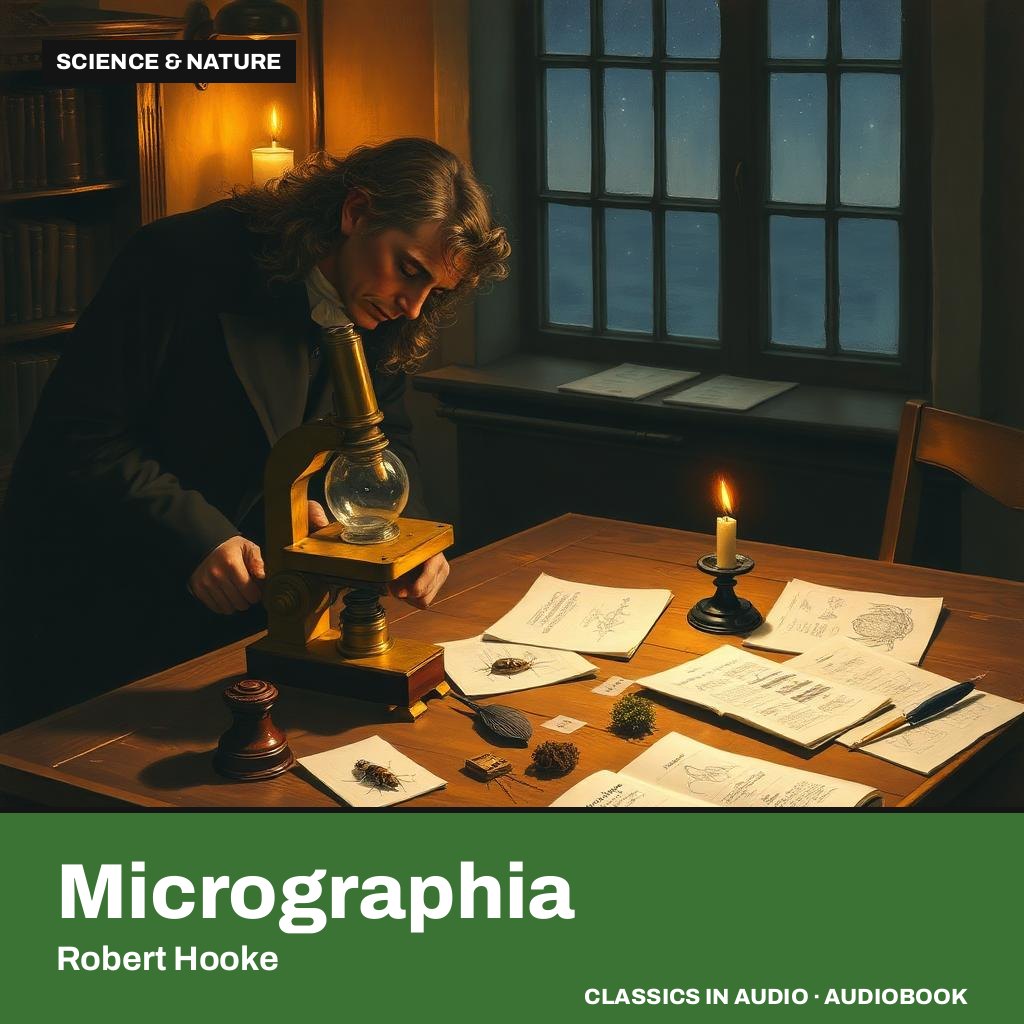
Micrographia
Some Physiological Descriptions of Minute Bodies Made by Magnifying Glasses with Observations and Inquiries Thereupon
by Robert Hooke (1635–1703)
Unabridged audiobook · about 14 hr 11 min · English · read by a synthetic voice · MP3, no DRM
€5.90
Buy 2 audiobooks or more: −10%. Buy 5 or more: −20%.
Secure payment by Stripe. Your download link is e-mailed to you at once: the first 30 minutes are usually ready within a few minutes, and the rest follows while you listen. Listen online or download the MP3.
Micrographia, published in London in 1665, is one of the first books to show readers what the world looks like through a microscope. Robert Hooke, then curator of experiments at the Royal Society, set out to record what he saw through magnifying lenses, and he also drew the plates himself. He examines a needle's point, the edge of a razor, a printed full stop, a snowflake, a piece of silk, and the wings and eyes of insects. The foldout engraving of a flea is the most famous, but the same attention goes to mould, nettle stings and fish scales.
The book is part scientific report and part argument. Hooke opens with dedications to Charles II and the Royal Society, then a preface on the limits of the senses, memory and reason, and on how instruments might repair them. His own conjectures sit beside careful description, and he labels guesses as guesses. In one section he looks at thin slices of cork and calls the tiny compartments he sees "cells", a word biology still uses.
For a modern listener it is a chance to share the surprise of a first look at a hidden scale of nature, in the prose of Restoration England.
Text: Project Gutenberg edition no. 15491, read without its licence notices.
More science & nature
 Body-build and Its InheritanceCharles Benedict Davenport7 hr 56 min€4.90
 On the Origin of Species By Means of Natural SelectionCharles Darwin15 hr 22 min€6.90
 The Interpretation of DreamsSigmund Freud20 hr 00 min€6.90
 The Origin of Species by Means of Natural SelectionCharles Darwin20 hr 41 min€7.90
 Novum OrganumFrancis Bacon8 hr 50 min€4.90
 The Magic of Jewels and CharmsGeorge Frederick Kunz13 hr 31 min€5.90