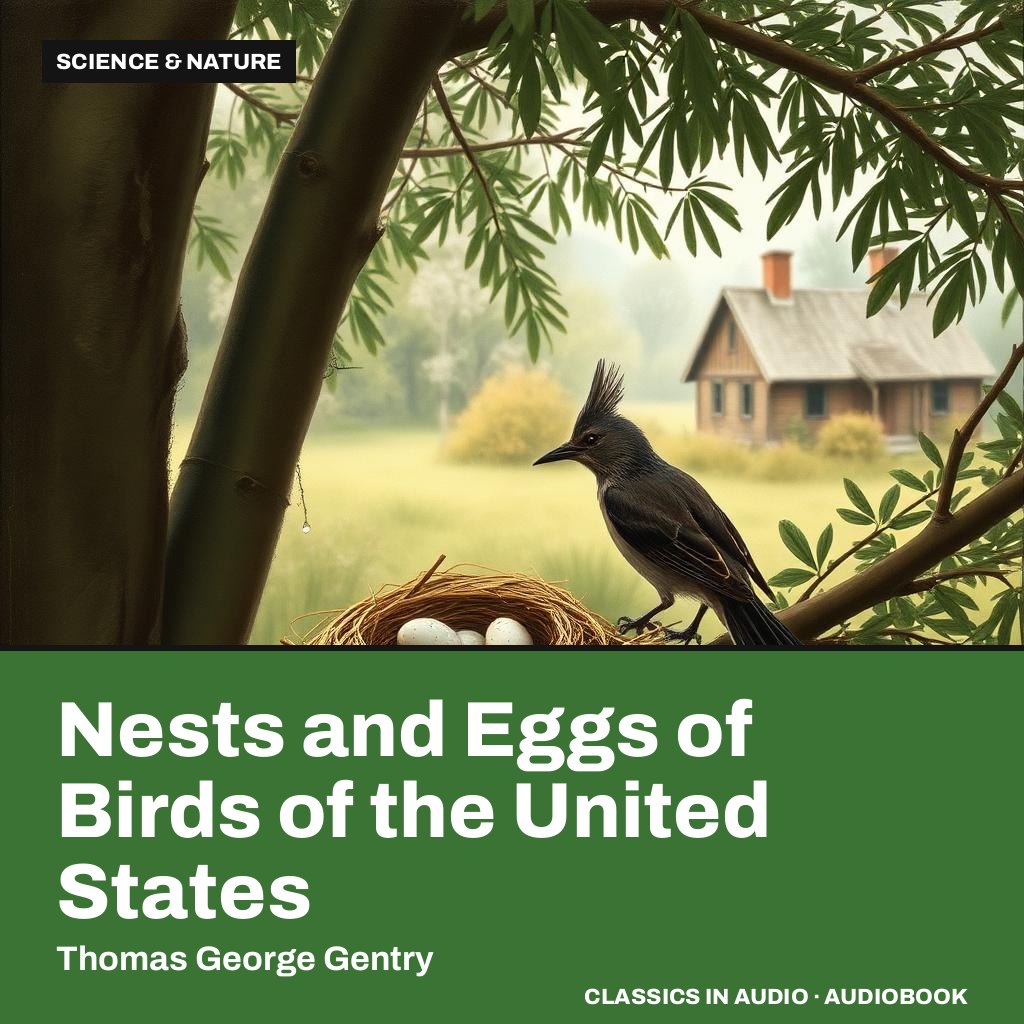
Nests and Eggs of Birds of the United States
Illustrated
by Thomas George Gentry (1843–1905)
Unabridged audiobook · about 10 hr 16 min · English · read by a synthetic voice · MP3, no DRM
€5.90
Buy 2 audiobooks or more: −10%. Buy 5 or more: −20%.
Secure payment by Stripe. Your download link is e-mailed to you at once: the first 30 minutes are usually ready within a few minutes, and the rest follows while you listen. Listen online or download the MP3.
Nests and Eggs of Birds of the United States is a nineteenth-century natural history book built around colour plates of birds beside their nests and eggs. It first appeared in numbers, and by the time the preface was signed in Germantown, Philadelphia, in May 1882, the plan had changed: readers wanted the birds shown with their nests, so the publisher added them, even to the earlier plates.
Thomas G. Gentry, a Philadelphia naturalist, wrote the text. For each species he follows the year: arrival of a migrant, pairing, choice of a building site, the nest itself, the eggs, and the departure south. For resident birds he adds the winter. The opening plate, on the Cedar-Bird, describes flocks that stay together through the colder months and break into pairs only in late May or June, then search hedges and woods for a shrub or tree, often a cedar, to hide a nest. Gentry draws on his own field observation and on Wilson, Audubon, Nuttall and other writers he names.
He also hoped that pictures of birds' homes would discourage boys from robbing nests. The book is a clear record of how American birds were observed and loved in the 1880s, and it still reads as a practical account of how birds raise their young.
Text: Project Gutenberg edition no. 45063, read without its licence notices.
More by Thomas George Gentry
More science & nature
 Body-build and Its InheritanceCharles Benedict Davenport7 hr 56 min€4.90
 On the Origin of Species By Means of Natural SelectionCharles Darwin15 hr 22 min€6.90
 The Interpretation of DreamsSigmund Freud20 hr 00 min€6.90
 The Origin of Species by Means of Natural SelectionCharles Darwin20 hr 41 min€7.90
 Novum OrganumFrancis Bacon8 hr 50 min€4.90
 The Magic of Jewels and CharmsGeorge Frederick Kunz13 hr 31 min€5.90