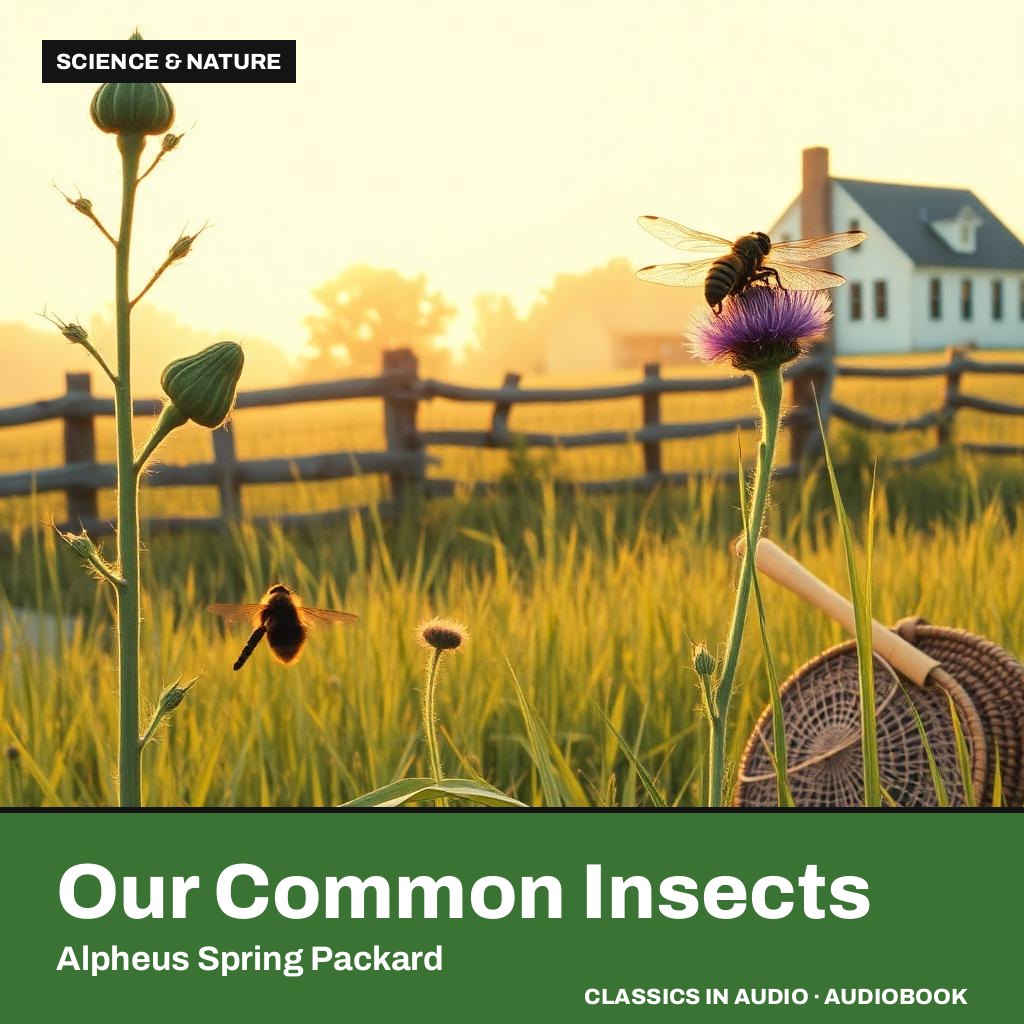
Our Common Insects
A Popular Account of the Insects of Our Fields, Forests, Gardens and Houses
by Alpheus Spring Packard (1839–1905)
Unabridged audiobook · about 6 hr 46 min · English · read by a synthetic voice · MP3, no DRM
€4.90
Buy 2 audiobooks or more: −10%. Buy 5 or more: −20%.
Secure payment by Stripe. Your download link is e-mailed to you at once: the first 30 minutes are usually ready within a few minutes, and the rest follows while you listen. Listen online or download the MP3.
Our Common Insects is a nineteenth-century natural history of the creatures found in American fields, woods, gardens and homes. It grew out of a series of essays that A. S. Packard first published in the American Naturalist between 1867 and 1871, and the book was gathered together in Salem, Massachusetts, in 1873. Packard was a Massachusetts naturalist who wrote widely on entomology, and he writes here for ordinary readers who want to know what they are looking at.
The opening chapter asks a plain question: what is an insect? Packard answers by taking one apart. He counts the rings of the body, the three regions that give the insects their name, the pores along the sides through which they breathe, and the tubular heart that can be seen beating in a thin-skinned caterpillar. He sets spiders and centipedes apart from true insects, and compares an insect to a horse with the help of an unexpected comparison to a printing press.
The book then turns to the habits and forms of familiar species, and it closes its argument with a bold chapter on the possible ancestry of insects, written when evolution was still a fresh and disputed idea. It offers a clear view of how a working scientist taught the subject in the 1870s, and much of the observation still holds up.
Text: Project Gutenberg edition no. 24409, read without its licence notices.
More by Alpheus Spring Packard
 A Text-book of EntomologyAlpheus Spring Packard28 hr 04 min€7.90
 Lamarck, the Founder of EvolutionAlpheus Spring Packard12 hr 54 min€5.90
More science & nature
 Body-build and Its InheritanceCharles Benedict Davenport7 hr 56 min€4.90
 On the Origin of Species By Means of Natural SelectionCharles Darwin15 hr 22 min€6.90
 The Interpretation of DreamsSigmund Freud20 hr 00 min€6.90
 The Origin of Species by Means of Natural SelectionCharles Darwin20 hr 41 min€7.90
 Novum OrganumFrancis Bacon8 hr 50 min€4.90
 The Magic of Jewels and CharmsGeorge Frederick Kunz13 hr 31 min€5.90