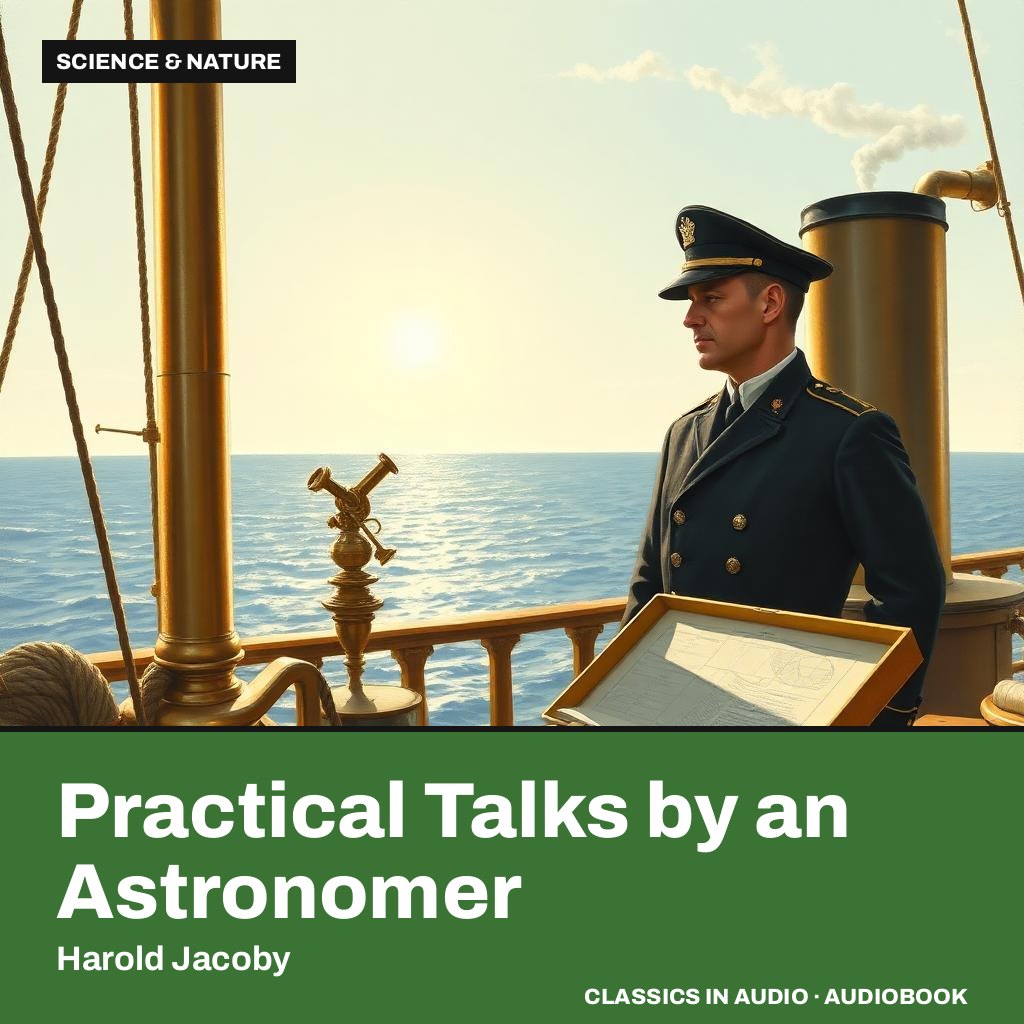
Practical Talks by an Astronomer
by Harold Jacoby (1865–1932)
Unabridged audiobook · about 4 hr 09 min · English · read by a synthetic voice · MP3, no DRM
€3.90
Buy 2 audiobooks or more: −10%. Buy 5 or more: −20%.
Secure payment by Stripe. Your download link is e-mailed to you at once: the first 30 minutes are usually ready within a few minutes, and the rest follows while you listen. Listen online or download the MP3.
Practical Talks by an Astronomer is a collection of eighteen short essays on separate astronomical subjects, written around the turn of the twentieth century for readers who want a half-hour's reading on one topic rather than a full course in the science. Each piece stands alone. Harold Jacoby, who taught astronomy at Columbia University, avoids technical language and picks subjects with wide appeal.
The range is generous. The opening essay explains how a ship's officers find their position at sea, beginning with an anecdote about the Royal Astronomical Society's archives and an old captain who reached Rio de Janeiro by sailing to the right latitude and then heading due west, with no way of knowing the longitude. Other chapters take up the Pleiades, the pole-star, nebulae, stars that flare up suddenly, Galileo, Saturn's rings, the making of a sun-dial, the standards by which the world keeps time, and the wobble of the Earth's pole. Several deal with the instruments and photographs of the day, including the great telescope at Yerkes. A chapter on the Moon hoax recalls a famous newspaper invention about life on the Moon.
The book shows what astronomers knew in 1902, and how they explained it to the public. Listeners will find old puzzles set out clearly, with a few dry jokes along the way.
Text: Project Gutenberg edition no. 53396, read without its licence notices.
More science & nature
 Body-build and Its InheritanceCharles Benedict Davenport7 hr 56 min€4.90
 On the Origin of Species By Means of Natural SelectionCharles Darwin15 hr 22 min€6.90
 The Interpretation of DreamsSigmund Freud20 hr 00 min€6.90
 The Origin of Species by Means of Natural SelectionCharles Darwin20 hr 41 min€7.90
 Novum OrganumFrancis Bacon8 hr 50 min€4.90
 The Magic of Jewels and CharmsGeorge Frederick Kunz13 hr 31 min€5.90