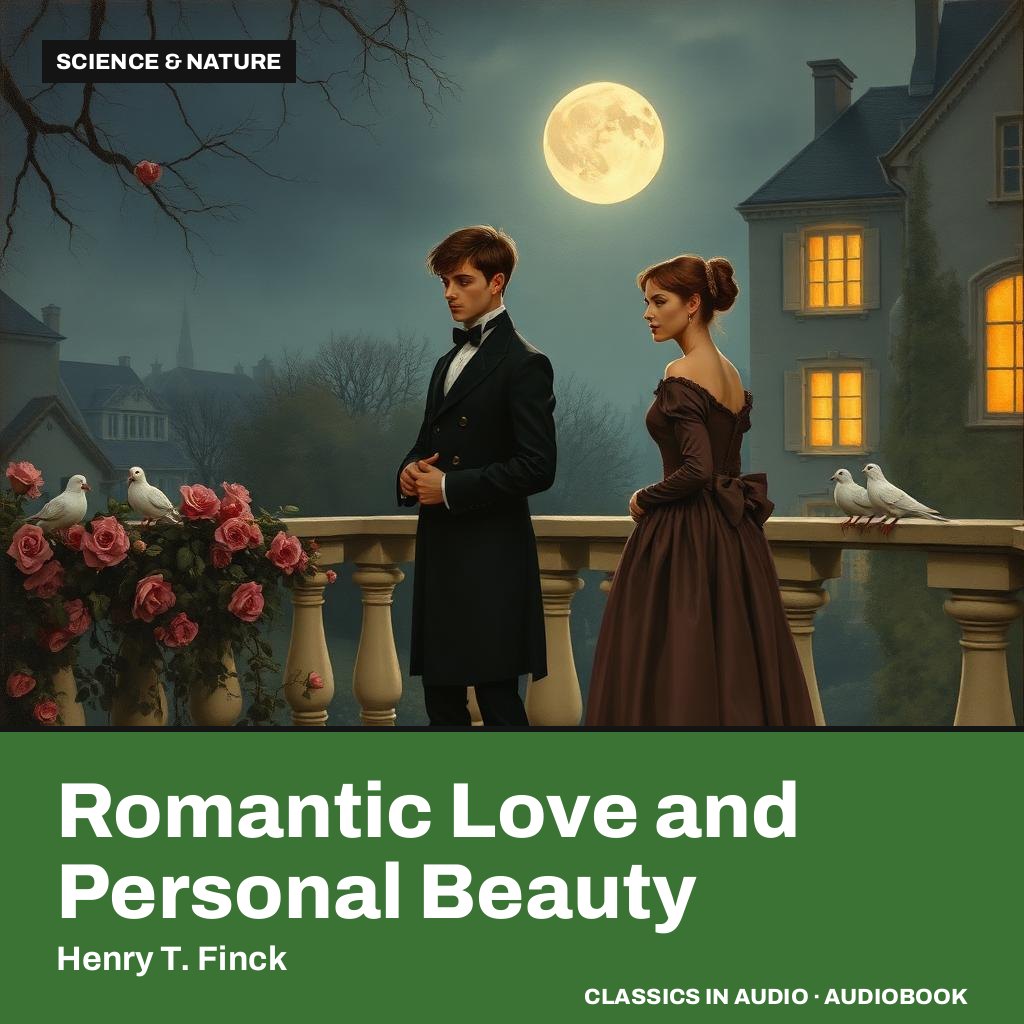
Romantic Love and Personal Beauty
Their Development, Causal Relations, Historic and National Peculiarities
by Henry T. Finck (1854–1926)
Unabridged audiobook · about 23 hr 25 min · English · read by a synthetic voice · MP3, no DRM
€7.90
Buy 2 audiobooks or more: −10%. Buy 5 or more: −20%.
Secure payment by Stripe. Your download link is e-mailed to you at once: the first 30 minutes are usually ready within a few minutes, and the rest follows while you listen. Listen online or download the MP3.
Henry T. Finck's study, first published in the 1880s, asks two questions: how did romantic love arise, and how did our ideas of personal beauty take shape? He treats love as something that developed over time rather than a constant of human nature. The long contents list shows his method. He starts with courtship among animals, moves through accounts of so-called savages, then follows the history of love through Egypt, ancient Israel, Greece, Rome, the age of chivalry and the modern period.
The middle of the book turns to practical and psychological matters: coyness, jealousy, flirtation, love at first sight, the loves of men of genius, old maids and bachelors, kissing, and the supposed cures for lovesickness. Finck also compares the French, Italian, Spanish, German, English and American ways of loving, and sets out Schopenhauer's theory that love is an illusion serving the species.
The final sections take up beauty: health, fashion, dance, the foot, the waist and the bosom. Finck was a music critic and a writer on evolution and taste, and he argued from Darwin and Spencer. Many of his claims about race and sex now look dated, and that is part of the interest. It shows how a Victorian author tried to explain courtship with the science and prejudices of his day.
Text: Project Gutenberg edition no. 60054, read without its licence notices.
More by Henry T. Finck
More science & nature
 Body-build and Its InheritanceCharles Benedict Davenport7 hr 56 min€4.90
 On the Origin of Species By Means of Natural SelectionCharles Darwin15 hr 22 min€6.90
 The Interpretation of DreamsSigmund Freud20 hr 00 min€6.90
 The Origin of Species by Means of Natural SelectionCharles Darwin20 hr 41 min€7.90
 Novum OrganumFrancis Bacon8 hr 50 min€4.90
 The Magic of Jewels and CharmsGeorge Frederick Kunz13 hr 31 min€5.90