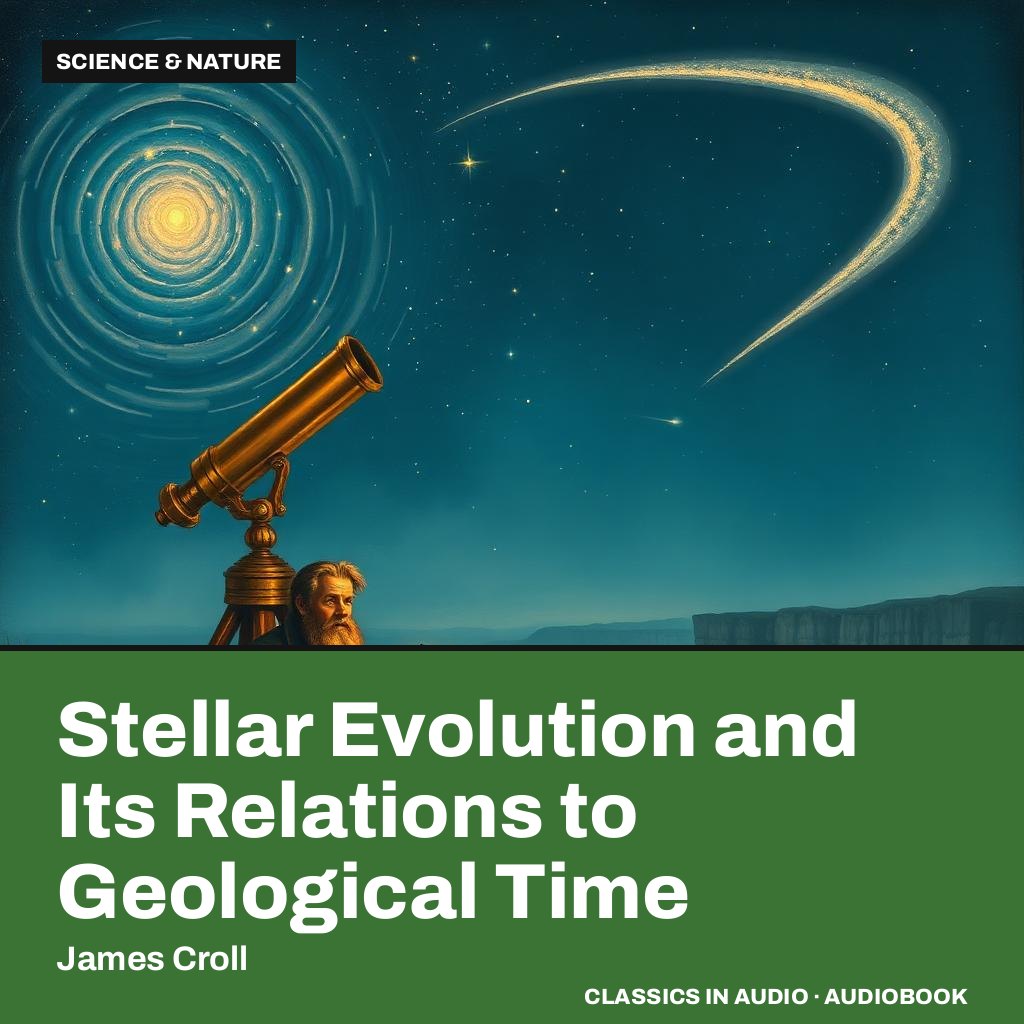
Stellar Evolution and Its Relations to Geological Time
by James Croll (1821–1890)
Unabridged audiobook · about 3 hr 03 min · English · read by a synthetic voice · MP3, no DRM
€3.90
Buy 2 audiobooks or more: −10%. Buy 5 or more: −20%.
Secure payment by Stripe. Your download link is e-mailed to you at once: the first 30 minutes are usually ready within a few minutes, and the rest follows while you listen. Listen online or download the MP3.
James Croll's 1889 volume asks a simple question with large consequences: where did the sun's heat come from, and how long has it been shining? Croll, a Scottish self-taught scientist who worked as a janitor before becoming a geologist and is remembered for his astronomical theory of ice ages, argues against the then-popular view that gravitational contraction alone could supply the sun's energy. Such a source, he points out, can be calculated and has a firm ceiling.
His alternative is the impact theory. Stars, he proposes, owe their heat to violent collisions of vast bodies in space, and he follows the idea through meteorites, comets, the motions of stars, binary systems, sudden stellar outbursts and the many shapes of nebulae. He draws on the spectroscopic work of Norman Lockyer, then newly changing how nebulae were understood.
The second part turns to the earth itself. Geological evidence such as rates of erosion, faults and the date of the Glacial Epoch, together with the slow pace of biological change, is used to show that the sun has burned for a very long time. The final part reviews Victorian speculations on what matter was like before nebulae existed. It is a revealing record of a debate over the age of the earth and the stars, conducted just before modern physics changed the answer.
Text: Project Gutenberg edition no. 49200, read without its licence notices.
More by James Croll
More science & nature
 Body-build and Its InheritanceCharles Benedict Davenport7 hr 56 min€4.90
 On the Origin of Species By Means of Natural SelectionCharles Darwin15 hr 22 min€6.90
 The Interpretation of DreamsSigmund Freud20 hr 00 min€6.90
 The Origin of Species by Means of Natural SelectionCharles Darwin20 hr 41 min€7.90
 Novum OrganumFrancis Bacon8 hr 50 min€4.90
 The Magic of Jewels and CharmsGeorge Frederick Kunz13 hr 31 min€5.90