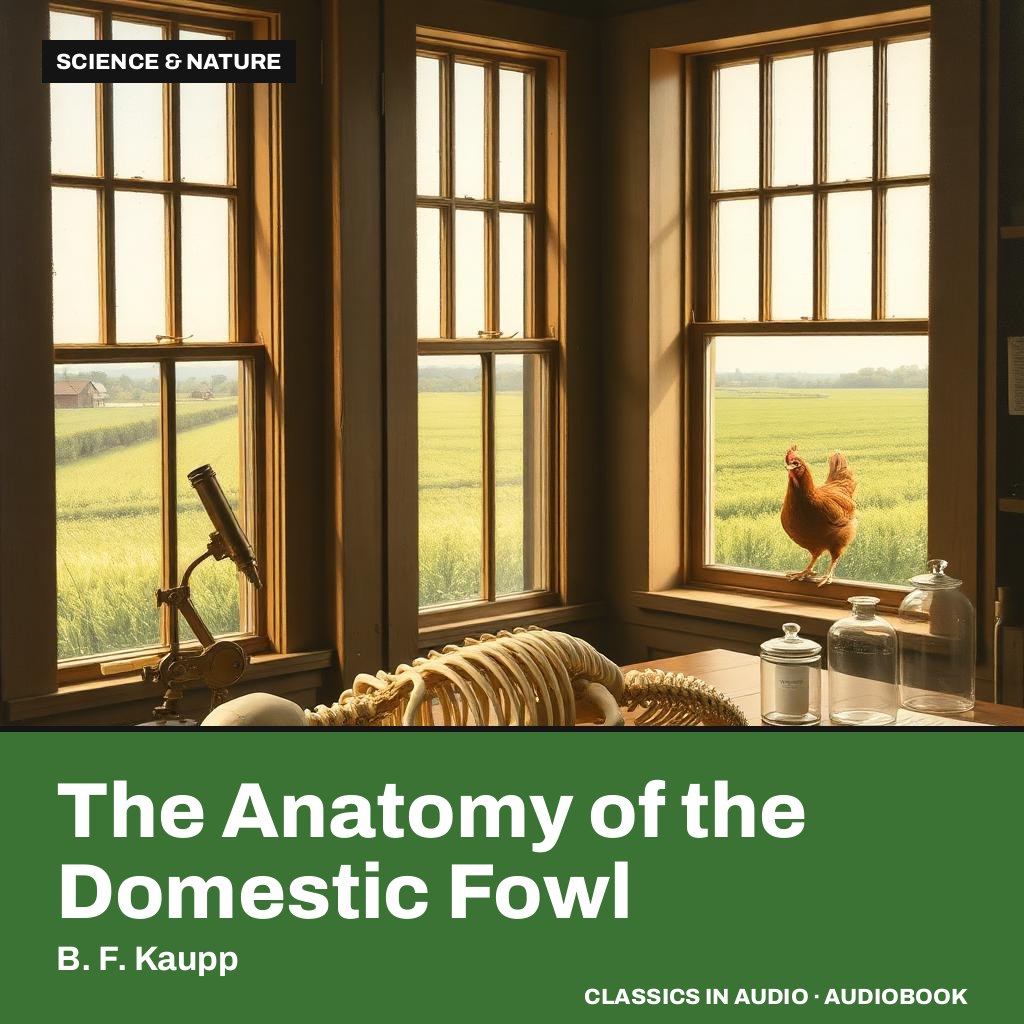
The Anatomy of the Domestic Fowl
by B. F. Kaupp (1874–1954)
Unabridged audiobook · about 11 hr 21 min · English · read by a synthetic voice · MP3, no DRM
€5.90
Buy 2 audiobooks or more: −10%. Buy 5 or more: −20%.
Secure payment by Stripe. Your download link is e-mailed to you at once: the first 30 minutes are usually ready within a few minutes, and the rest follows while you listen. Listen online or download the MP3.
The Anatomy of the Domestic Fowl is a college textbook from 1918, written to fill a plain gap: although agricultural colleges and experiment stations across the United States were teaching advanced poultry husbandry, no complete English-language text on the chicken's body existed. B. F. Kaupp, who taught at the North Carolina State College of Agriculture and had earlier directed the anatomy laboratory at Kansas City Veterinary College, set out to supply one.
The book moves system by system. It begins with the skeleton and its joints, then turns to muscles, and goes on to the digestive tract, from the crop and the two-part stomach to the gizzard and the paired cæca. Later chapters cover the kidneys, the reproductive organs and the formation of the egg in the oviduct, the lungs and the air-sacs that extend through the body, the heart and its vessels, the brain and nerves, and the sense organs. A closing section on embryology follows the developing chick and includes a plan for laboratory study.
Kaupp openly calls his work a first attempt and invites corrections. Today it offers a detailed look at how farm science was taught a century ago, and a patient explanation of the bird behind the egg and the Sunday roast, for listeners curious about biology, farming or the history of veterinary teaching.
Text: Project Gutenberg edition no. 71368, read without its licence notices.
More science & nature
 Body-build and Its InheritanceCharles Benedict Davenport7 hr 56 min€4.90
 On the Origin of Species By Means of Natural SelectionCharles Darwin15 hr 22 min€6.90
 The Interpretation of DreamsSigmund Freud20 hr 00 min€6.90
 The Origin of Species by Means of Natural SelectionCharles Darwin20 hr 41 min€7.90
 Novum OrganumFrancis Bacon8 hr 50 min€4.90
 The Magic of Jewels and CharmsGeorge Frederick Kunz13 hr 31 min€5.90