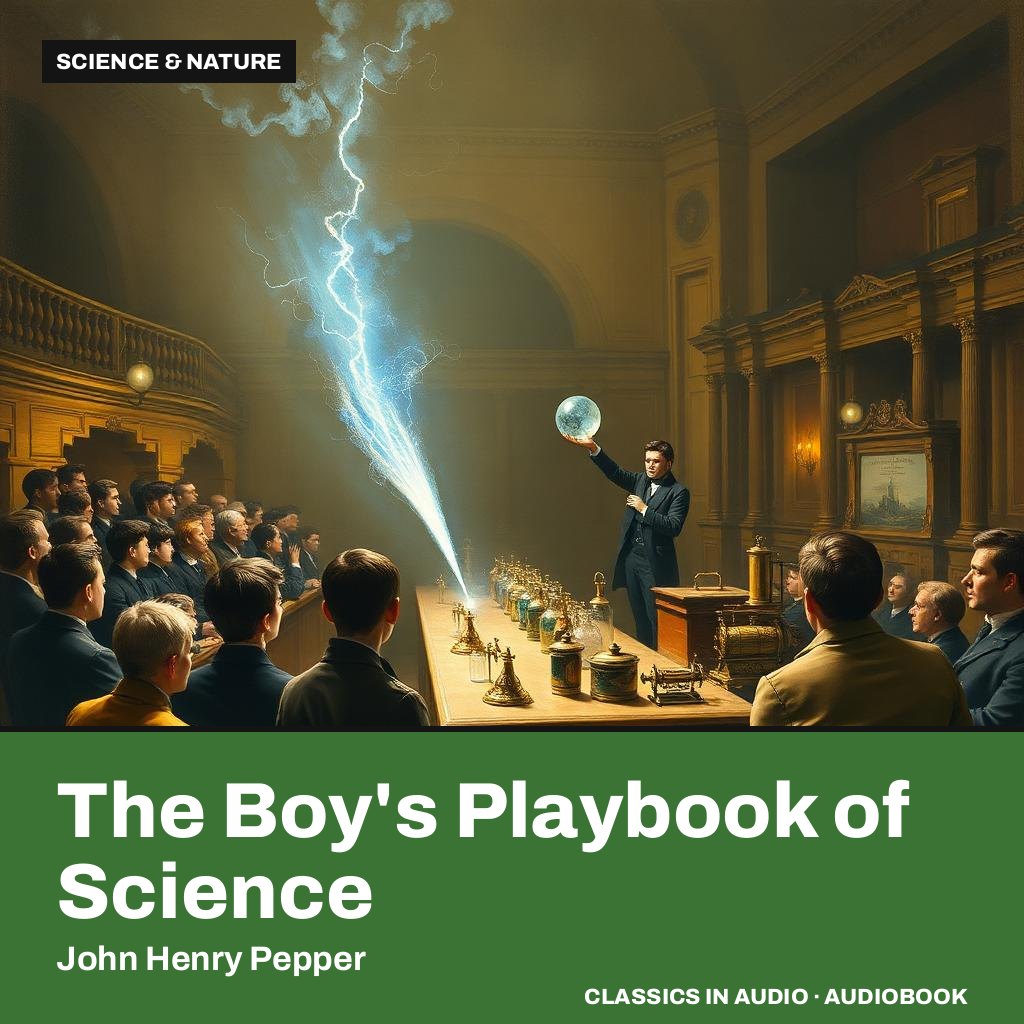
The Boy's Playbook of Science
Including the Various Manipulations and Arrangements of Chemical and Philosophical Apparatus Required for the Successful Performance of Scientific Experiments in Illustration of the Elementary Branches of Chemistry and Natural Philosophy
by John Henry Pepper (1821–1900)
Unabridged audiobook · about 14 hr 27 min · English · read by a synthetic voice · MP3, no DRM
€5.90
Buy 2 audiobooks or more: −10%. Buy 5 or more: −20%.
Secure payment by Stripe. Your download link is e-mailed to you at once: the first 30 minutes are usually ready within a few minutes, and the rest follows while you listen. Listen online or download the MP3.
John Henry Pepper's Victorian handbook of home experiments is a practical guide for young people who want to see science done, not just described. Its twenty-nine chapters move from the basic properties of matter, centrifugal force and the centre of gravity to crystallization, chemistry, electricity, magnetism, optics, heat and the steam-engine. Each topic comes with step-by-step instructions, lists of apparatus and engraved diagrams.
Pepper directed the Royal Polytechnic Institution in London, where his lectures were famous for their showmanship; the stage illusion known as Pepper's Ghost is named after him. He wrote this book for the boys who wrote to him after those lectures asking how a particular experiment was done. It is dedicated to the children of the chemist Lyon Playfair, and its introduction pleads for a hobby that rewards a boy on a wet afternoon or a long winter evening.
The book is also a record of what science looked like in the mid-1800s: the electric telegraph is a recent marvel, induction coils are the latest apparatus, and the steam-engine is explained as a working machine. Listeners who like to know how things work, or how people once taught it, will find plenty here.
Text: Project Gutenberg edition no. 41839, read without its licence notices.
More science & nature
 Body-build and Its InheritanceCharles Benedict Davenport7 hr 56 min€4.90
 On the Origin of Species By Means of Natural SelectionCharles Darwin15 hr 22 min€6.90
 The Interpretation of DreamsSigmund Freud20 hr 00 min€6.90
 The Origin of Species by Means of Natural SelectionCharles Darwin20 hr 41 min€7.90
 Novum OrganumFrancis Bacon8 hr 50 min€4.90
 The Magic of Jewels and CharmsGeorge Frederick Kunz13 hr 31 min€5.90