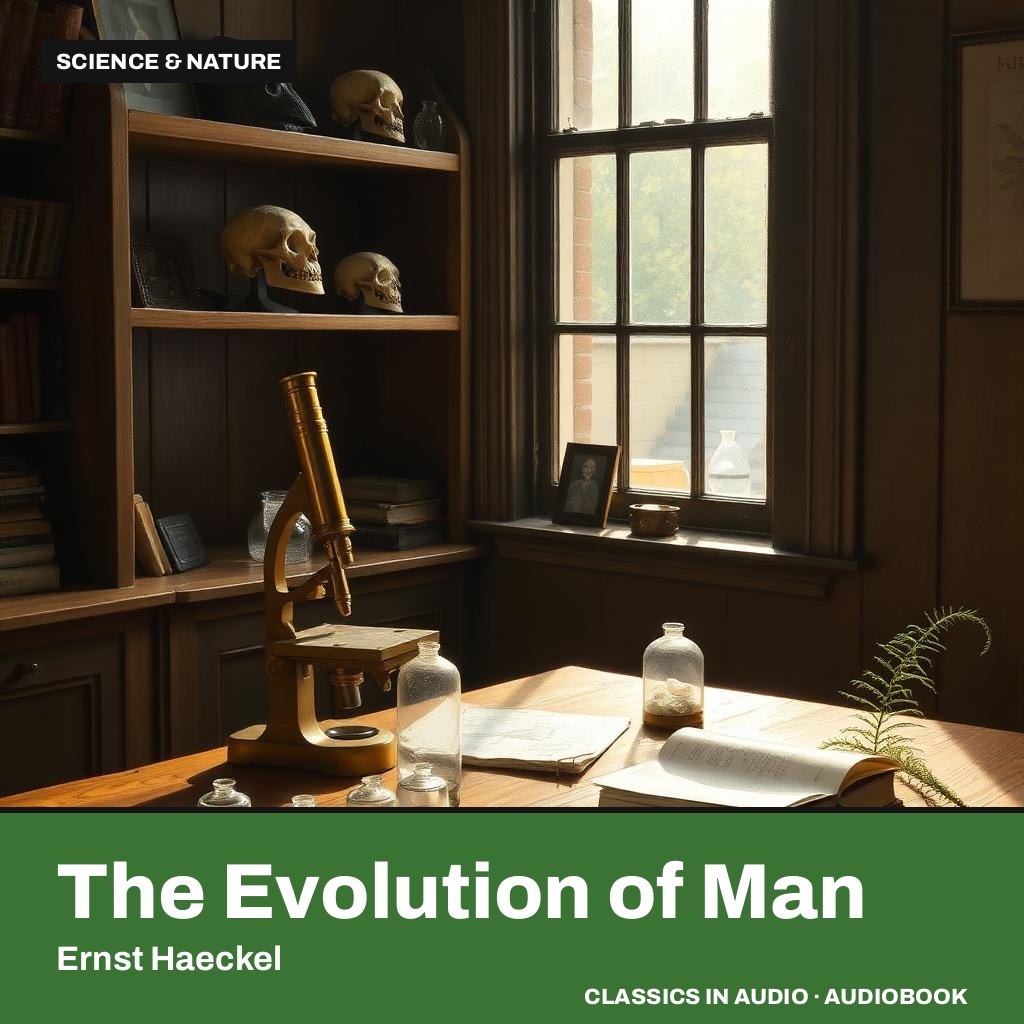
The Evolution of Man
by Ernst Haeckel (1834–1919)
Unabridged audiobook · about 21 hr 34 min · English · read by a synthetic voice · MP3, no DRM
€7.90
Buy 2 audiobooks or more: −10%. Buy 5 or more: −20%.
Secure payment by Stripe. Your download link is e-mailed to you at once: the first 30 minutes are usually ready within a few minutes, and the rest follows while you listen. Listen online or download the MP3.
Ernst Haeckel's The Evolution of Man sets out to explain where human beings come from by following two lines of evidence side by side: how each person develops from a single fertilised egg, and how the human line descended over vast ages from simpler animals. Haeckel, a German zoologist who taught at Jena and was Darwin's most energetic champion on the Continent, called the first study ontogeny and the second phylogeny, and he argued that the first repeats the outline of the second.
The chapters move step by step. They begin with the egg and the sperm, then follow the dividing cells through the gastrula, a hollow two-layered stage he found in animals from sponges to rabbits. From there the book looks at the lancelet and the sea-squirt, humble creatures he treated as clues to our backboned origins. He then lists our supposed forebears in turn: single-celled protists, worm-like animals, fish, five-toed land vertebrates and apes, before tracing the nervous system, the senses, the gut and the blood vessels.
The book was published in the late nineteenth century, and some of its claims, notably his strict law of recapitulation, have since been rejected or heavily revised. It remains a vivid record of how early evolutionists argued, drawing on embryos of chicks, sharks, bats and humans, and of the confidence and controversy of that age.
Text: Project Gutenberg edition no. 8700, read without its licence notices.
More by Ernst Haeckel
 The Riddle of the Universe at the Close of the Nineteenth CenturyErnst Haeckel11 hr 05 min€5.90
 The Wonders of LifeErnst Haeckel15 hr 14 min€6.90
 Monism as Connecting Religion and ScienceErnst Haeckel1 hr 41 min€3.90
 The Last LinkErnst Haeckel2 hr 26 min€3.90
 Last Words on EvolutionErnst Haeckel2 hr 50 min€3.90
More science & nature
 Body-build and Its InheritanceCharles Benedict Davenport7 hr 56 min€4.90
 On the Origin of Species By Means of Natural SelectionCharles Darwin15 hr 22 min€6.90
 The Interpretation of DreamsSigmund Freud20 hr 00 min€6.90
 The Origin of Species by Means of Natural SelectionCharles Darwin20 hr 41 min€7.90
 Novum OrganumFrancis Bacon8 hr 50 min€4.90
 The Magic of Jewels and CharmsGeorge Frederick Kunz13 hr 31 min€5.90