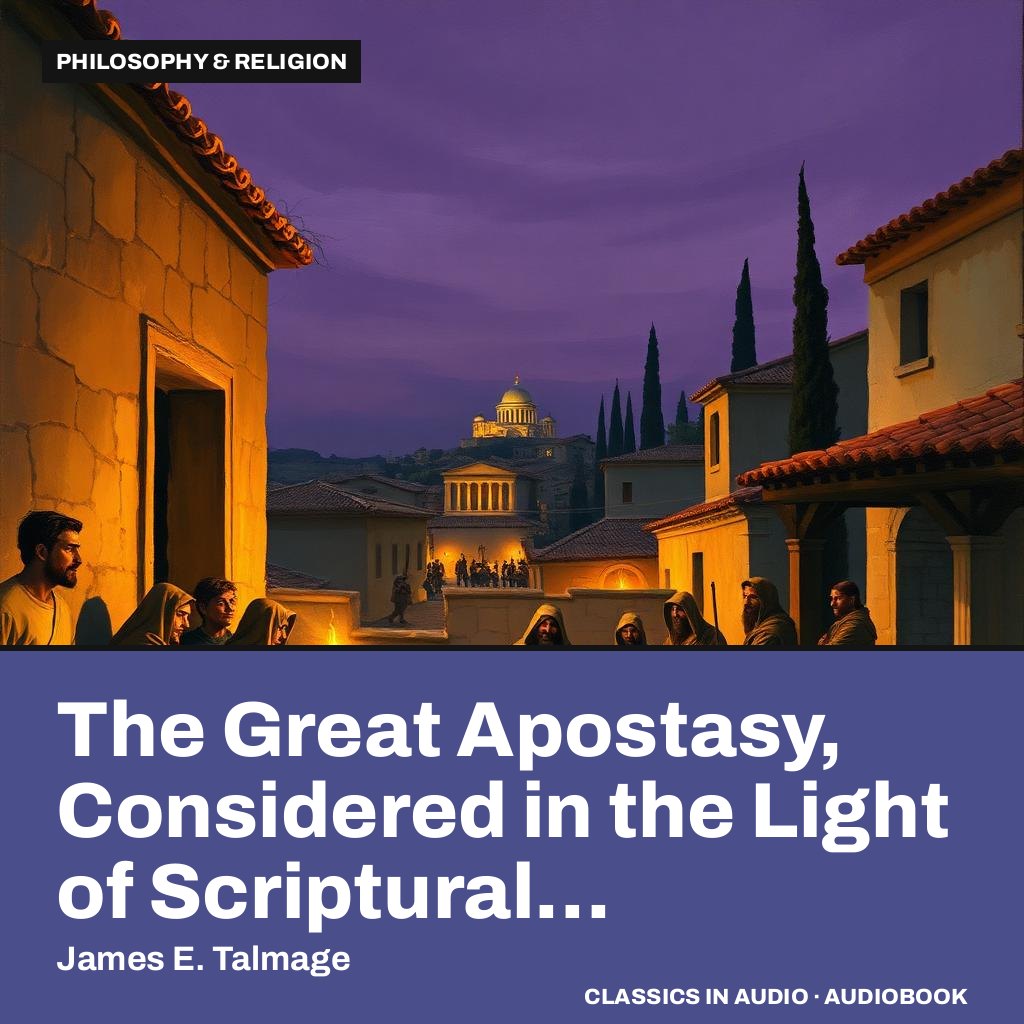
The Great Apostasy, Considered in the Light of Scriptural and Secular History
by James E. Talmage (1862–1933)
Unabridged audiobook · about 5 hr 10 min · English · read by a synthetic voice · MP3, no DRM
€4.90
Buy 2 audiobooks or more: −10%. Buy 5 or more: −20%.
Secure payment by Stripe. Your download link is e-mailed to you at once: the first 30 minutes are usually ready within a few minutes, and the rest follows while you listen. Listen online or download the MP3.
The Great Apostasy is a work of Latter-day Saint theology and church history, first published in 1909. It sets out to explain why, in the author's faith, the Christian church of the apostles is said to have lost its authority and divine character in the centuries after Christ. James E. Talmage, a geologist and chemist who became a member of the Quorum of the Twelve Apostles of his church, wrote it as a handbook for missionaries and study classes.
The argument moves through the Roman Empire of the first centuries. Talmage begins with the religious world of Jews, Samaritans and pagans at the start of the Christian era, then gathers New Testament warnings of decline from Paul, Peter, Jude and John. He turns to outside pressures, including the destruction of Jerusalem and the persecutions under Nero, Domitian and Diocletian, and then to the internal changes he blames: Greek philosophy mixed into doctrine, the creeds of Nicaea, and shifts in ritual and baptism.
The book is openly a statement of one tradition's claims, and it is best heard that way. It also offers a clear view of how a modern believer reads early Christian history, and of why that reading underlies the founding of the Latter-day Saint movement.
Text: Project Gutenberg edition no. 35514, read without its licence notices.
More by James E. Talmage
 Jesus the ChristJames E. Talmage28 hr 42 min€7.90
 The Articles of FaithJames E. Talmage16 hr 31 min€6.90
 The House of the LordJames E. Talmage7 hr 20 min€4.90
 The Vitality of MormonismJames E. Talmage9 hr 38 min€4.90





