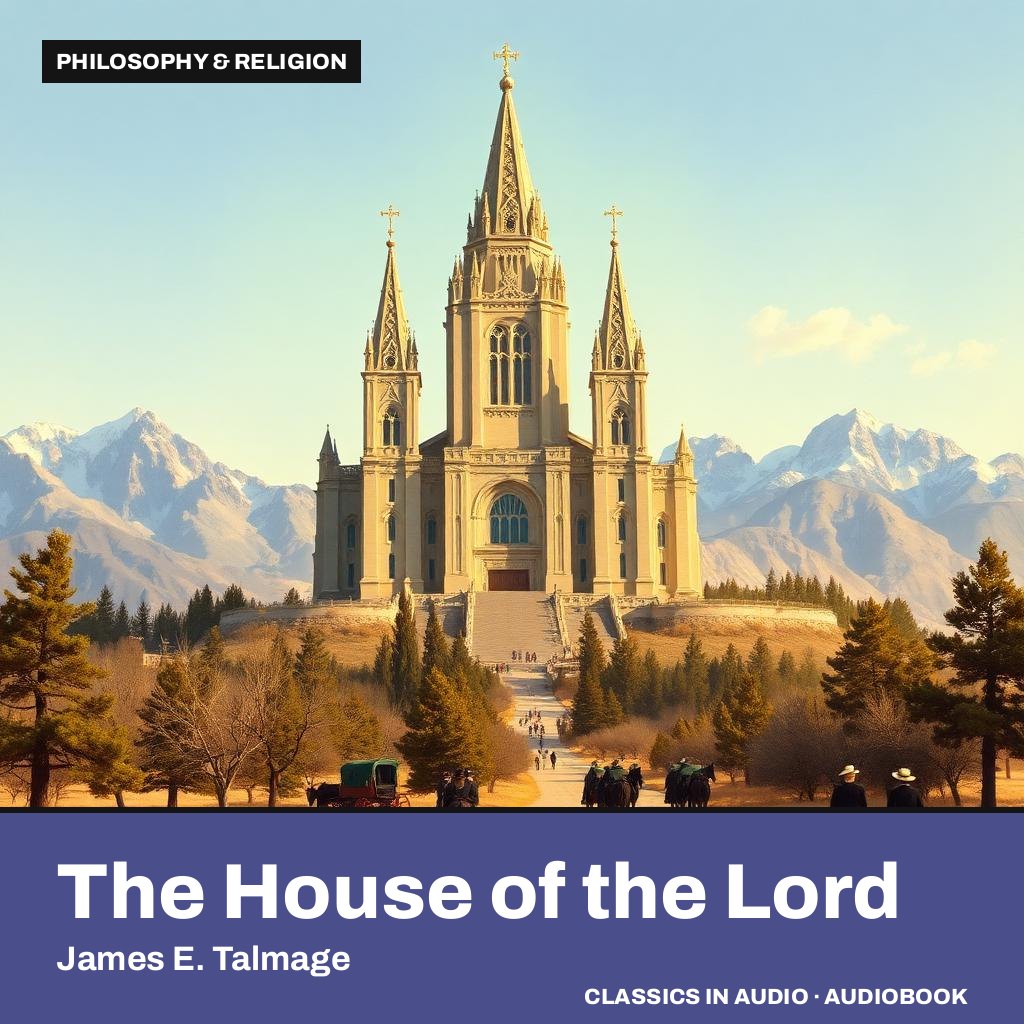
The House of the Lord
A Study of Holy Sanctuaries Ancient and Modern
by James E. Talmage (1862–1933)
Unabridged audiobook · about 7 hr 20 min · English · read by a synthetic voice · MP3, no DRM
€4.90
Buy 2 audiobooks or more: −10%. Buy 5 or more: −20%.
Secure payment by Stripe. Your download link is e-mailed to you at once: the first 30 minutes are usually ready within a few minutes, and the rest follows while you listen. Listen online or download the MP3.
The House of the Lord is a study of sacred buildings, from the portable sanctuary of ancient Israel to the temples raised by the Latter-day Saints in the nineteenth and early twentieth centuries. Published in 1912, it begins by defining what a temple is: a place, and more strictly a building, set apart for sacred rites and understood as the dwelling of Deity. Talmage then moves through the Tabernacle carried in the wilderness, the temples of Solomon, Zerubbabel and Herod, and the vision of Ezekiel, to serve as a point of comparison.
The larger part of the book concerns the modern era. It explains why the Church built temples, describes the ordinances performed in them, and traces the sites and buildings at Independence, Kirtland, Far West and Nauvoo. It then turns to the great temple at Salt Lake City, covering its long construction, its capstone, its dedication, its granite exterior and its interior rooms, before visiting the temples at St. George, Logan and Manti.
James E. Talmage was a geologist and chemist who became a leader of his church, and he wrote with a scholar's habit of listing sources and facts. Listeners curious about Mormon history, religious architecture or pioneer Utah will find an insider's account, written at the moment the Salt Lake Temple stood newly finished.
Text: Project Gutenberg edition no. 45149, read without its licence notices.
More by James E. Talmage
 Jesus the ChristJames E. Talmage28 hr 42 min€7.90
 The Articles of FaithJames E. Talmage16 hr 31 min€6.90
 The Great Apostasy, Considered in the Light of Scriptural and Secular HistoryJames E. Talmage5 hr 10 min€4.90
 The Vitality of MormonismJames E. Talmage9 hr 38 min€4.90





