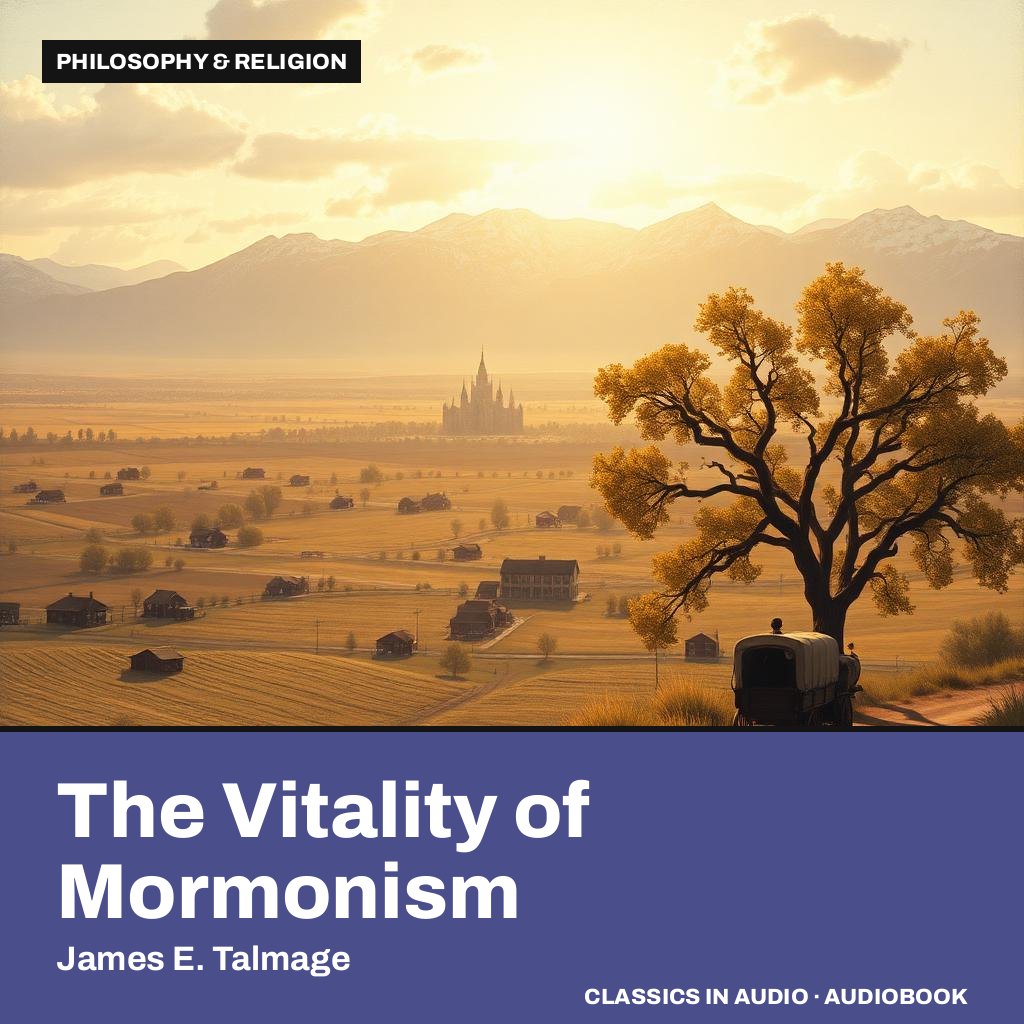
The Vitality of Mormonism
Brief Essays on Distinctive Doctrines of the Church of Jesus Christ of Latter-day Saints
by James E. Talmage (1862–1933)
Unabridged audiobook · about 9 hr 38 min · English · read by a synthetic voice · MP3, no DRM
€4.90
Buy 2 audiobooks or more: −10%. Buy 5 or more: −20%.
Secure payment by Stripe. Your download link is e-mailed to you at once: the first 30 minutes are usually ready within a few minutes, and the rest follows while you listen. Listen online or download the MP3.
The Vitality of Mormonism is a collection of one hundred and four short essays on the beliefs of the Church of Jesus Christ of Latter-day Saints, first published weekly over two years and gathered into a book in 1919. Its author, James E. Talmage, was a geologist and chemist before he became an apostle of the church, and he writes with a scientist's habit of laying out a case step by step.
A brief preface sets out nine points: the premortal existence of human spirits, life on earth as a period of testing, the fall, the need for a Redeemer, the apostasy of the early church, its restoration in the nineteenth century, and the church's mission to the nations. The essays then take up these themes one at a time. Titles range from the Trinity, baptism for the dead and the Book of Mormon to tithing, the Word of Wisdom, church and state, and marriage beyond death. Each piece is concise by design, and Talmage repeats quotations rather than send readers to cross references.
The book is an explanation from within the faith, written in Salt Lake City just after the First World War. It suits listeners who want to know what Latter-day Saints believed, and how a leading member of the church argued for it, in his own words.
Text: Project Gutenberg edition no. 47182, read without its licence notices.
More by James E. Talmage
 Jesus the ChristJames E. Talmage28 hr 42 min€7.90
 The Articles of FaithJames E. Talmage16 hr 31 min€6.90
 The House of the LordJames E. Talmage7 hr 20 min€4.90
 The Great Apostasy, Considered in the Light of Scriptural and Secular HistoryJames E. Talmage5 hr 10 min€4.90





