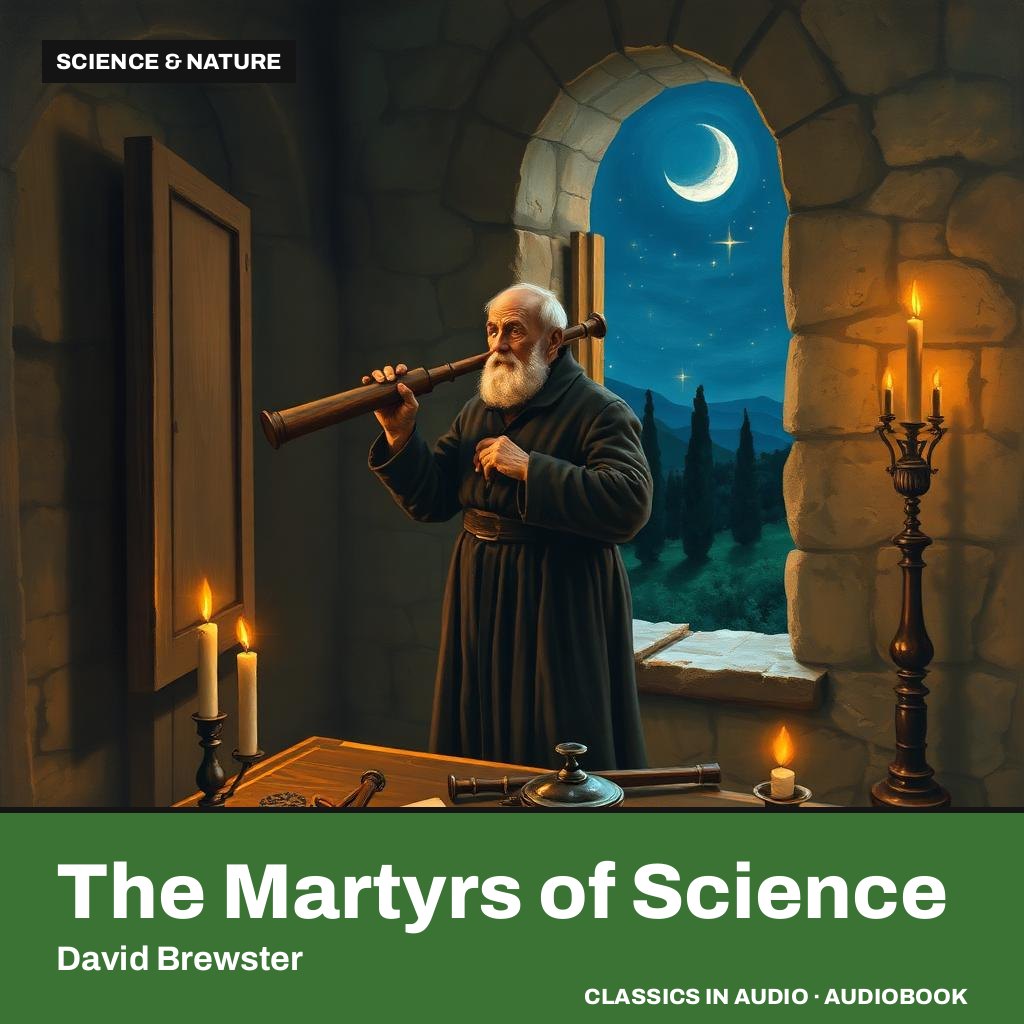
The Martyrs of Science
or, The Lives of Galileo, Tycho Brahe, and Kepler
by David Brewster (1781–1868)
Unabridged audiobook · about 4 hr 52 min · English · read by a synthetic voice · MP3, no DRM
€3.90
Buy 2 audiobooks or more: −10%. Buy 5 or more: −20%.
Secure payment by Stripe. Your download link is e-mailed to you at once: the first 30 minutes are usually ready within a few minutes, and the rest follows while you listen. Listen online or download the MP3.
David Brewster's double-edged title promises martyrs, and the book delivers three lives of men who changed how Europe understood the heavens: Galileo, Tycho Brahe and Johannes Kepler. It is a scientific biography first published in 1841, written in the confident, moral tone of the Victorian age, and it covers the years from the mid-sixteenth century to the 1640s.
Galileo's section follows him from his early passion for mathematics at Pisa and Padua to his first telescope, built after word reached him from Venice in 1609. It then moves to the moons of Jupiter, his quarrels with the Aristotelian professors, and his two summonses before the Inquisition. It ends in confinement at Arcetri, and Brewster also covers his later work on motion, and his failing sight. Tycho's life brings a very different figure: a Danish nobleman who lost part of his nose in a duel, observed a new star in Cassiopeia, and was given the island of Hven by his king to build an observatory and fill it with enormous instruments. Kepler enters as a younger mathematician, working from Tycho's measurements.
Brewster was a Scottish physicist known for his work on light and the inventor of the kaleidoscope. He writes as a scientist who knew the instruments well, and he is happy to judge his subjects, Galileo included. The result is a lively account of observation, patronage and dispute, and of how costly it could be to say that the Earth moves.
Text: Project Gutenberg edition no. 25992, read without its licence notices.
More science & nature
 Body-build and Its InheritanceCharles Benedict Davenport7 hr 56 min€4.90
 On the Origin of Species By Means of Natural SelectionCharles Darwin15 hr 22 min€6.90
 The Interpretation of DreamsSigmund Freud20 hr 00 min€6.90
 The Origin of Species by Means of Natural SelectionCharles Darwin20 hr 41 min€7.90
 Novum OrganumFrancis Bacon8 hr 50 min€4.90
 The Magic of Jewels and CharmsGeorge Frederick Kunz13 hr 31 min€5.90