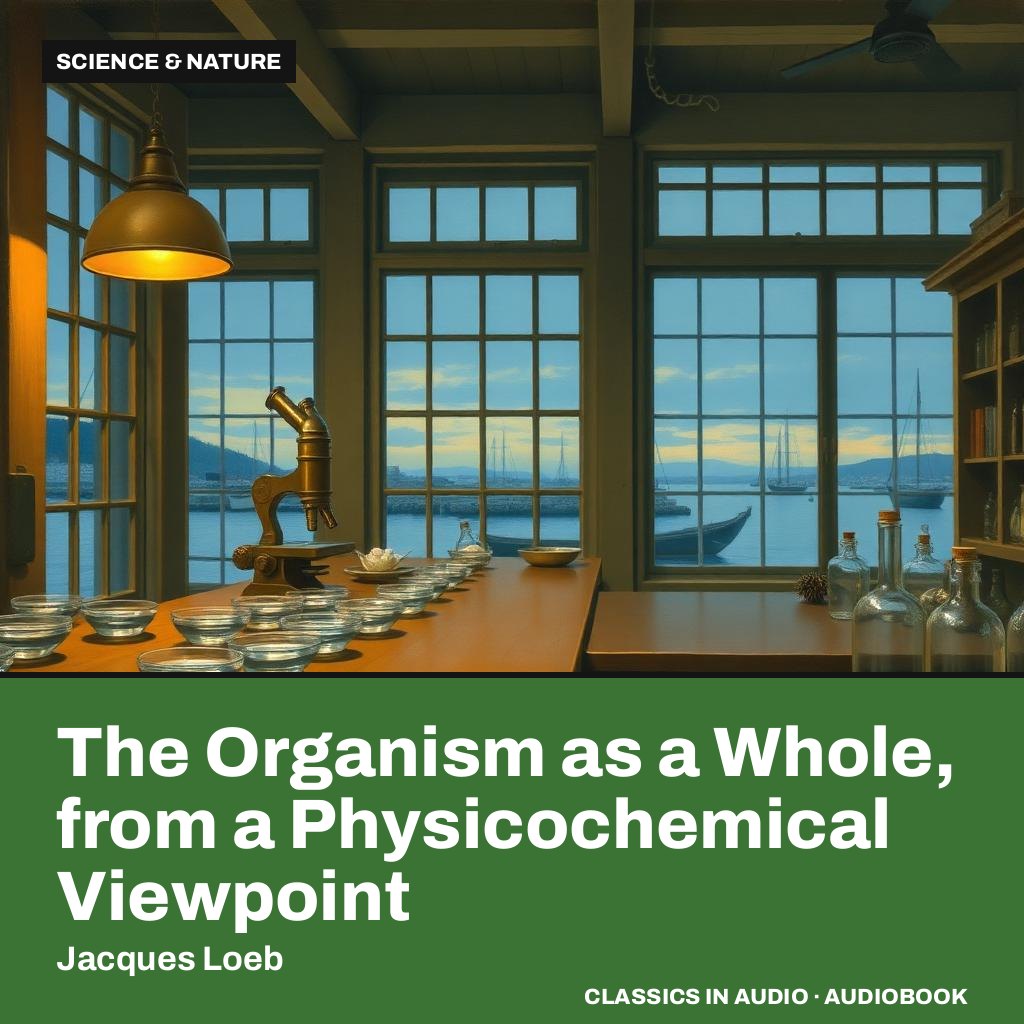
The Organism as a Whole, from a Physicochemical Viewpoint
by Jacques Loeb (1859–1924)
Unabridged audiobook · about 9 hr 01 min · English · read by a synthetic voice · MP3, no DRM
€4.90
Buy 2 audiobooks or more: −10%. Buy 5 or more: −20%.
Secure payment by Stripe. Your download link is e-mailed to you at once: the first 30 minutes are usually ready within a few minutes, and the rest follows while you listen. Listen online or download the MP3.
Published in 1916, this is a work of theoretical biology that asks a deceptively simple question: how does a living creature, built from many separately inherited traits, come to function as one harmonious whole? Jacques Loeb, a German-born physiologist who spent his later career at the Rockefeller Institute for Medical Research, was known for showing that unfertilized sea urchin eggs could be made to develop by chemical means. He draws on that experimental work here.
Loeb writes at a moment when Mendelian heredity seemed to portray the organism as a mosaic of independent characters, while vitalists appealed to a guiding force that no laboratory could measure. He rejects that appeal. His argument is that the egg's cytoplasm is already the embryo in rough form, and that the Mendelian factors in the chromosomes add individual details, probably through hormones and enzymes. The chapters move through the difference between living and dead matter, the chemical basis of genus and species, fertilization, and artificial parthenogenesis.
The book is dedicated to Diderot and the French freethinkers. It is a vivid record of how a leading experimenter of the period tried to settle the old dispute between mechanism and vitalism, and of how much was still unknown about heredity.
Text: Project Gutenberg edition no. 45962, read without its licence notices.
More science & nature
 Body-build and Its InheritanceCharles Benedict Davenport7 hr 56 min€4.90
 On the Origin of Species By Means of Natural SelectionCharles Darwin15 hr 22 min€6.90
 The Interpretation of DreamsSigmund Freud20 hr 00 min€6.90
 The Origin of Species by Means of Natural SelectionCharles Darwin20 hr 41 min€7.90
 Novum OrganumFrancis Bacon8 hr 50 min€4.90
 The Magic of Jewels and CharmsGeorge Frederick Kunz13 hr 31 min€5.90