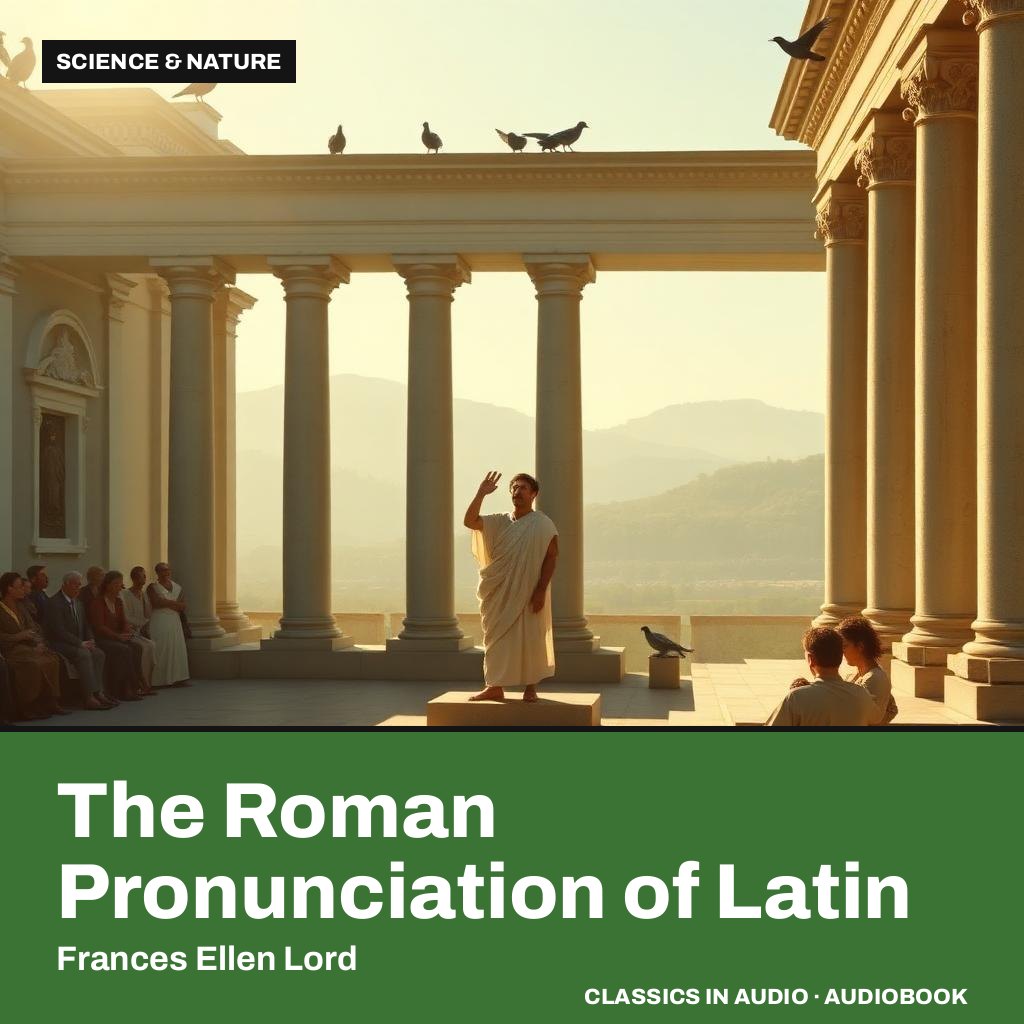
The Roman Pronunciation of Latin
Why We Use It and How to Use It
Unabridged audiobook · about 1 hr 43 min · English · read by a synthetic voice · MP3, no DRM
€3.90
Buy 2 audiobooks or more: −10%. Buy 5 or more: −20%.
Secure payment by Stripe. Your download link is e-mailed to you at once: the first 30 minutes are usually ready within a few minutes, and the rest follows while you listen. Listen online or download the MP3.
Frances E. Lord's short handbook, published in Boston by Ginn & Company in 1894, takes up a question that divided Latin classrooms in her day: should English-speaking students pronounce Latin the way the Romans of Cicero's and Horace's time most likely did, or simply read it with English sounds? She argues for the first, and she sets out her case plainly.
The book falls into two parts. The first, "Why We Use It," weighs the evidence for ancient pronunciation: the Latin grammarians, remarks scattered through classical authors, and inscriptions whose changing spellings point to changing sounds. Quintilian is among her witnesses, and she leans on the work of Oxford and Cambridge scholars such as Munro and Ellis. She goes through vowels, diphthongs, consonants, quantity, accent and pitch. The second part, "How To Use It," turns to practice, with elision, the length of syllables and the placing of stress. She also notes two points where she departs from common American teaching, the diphthong ae and the consonantal u.
Today the book is a record of how Latin was taught in the nineteenth century, and a clear introduction to the reasoning behind the sounds of the language. It suits students of Latin, teachers, and anyone curious about how scholars reconstruct a spoken language that no one has heard for centuries.
Text: Project Gutenberg edition no. 7528, read without its licence notices.
More science & nature
 Body-build and Its InheritanceCharles Benedict Davenport7 hr 56 min€4.90
 On the Origin of Species By Means of Natural SelectionCharles Darwin15 hr 22 min€6.90
 The Interpretation of DreamsSigmund Freud20 hr 00 min€6.90
 The Origin of Species by Means of Natural SelectionCharles Darwin20 hr 41 min€7.90
 Novum OrganumFrancis Bacon8 hr 50 min€4.90
 The Magic of Jewels and CharmsGeorge Frederick Kunz13 hr 31 min€5.90