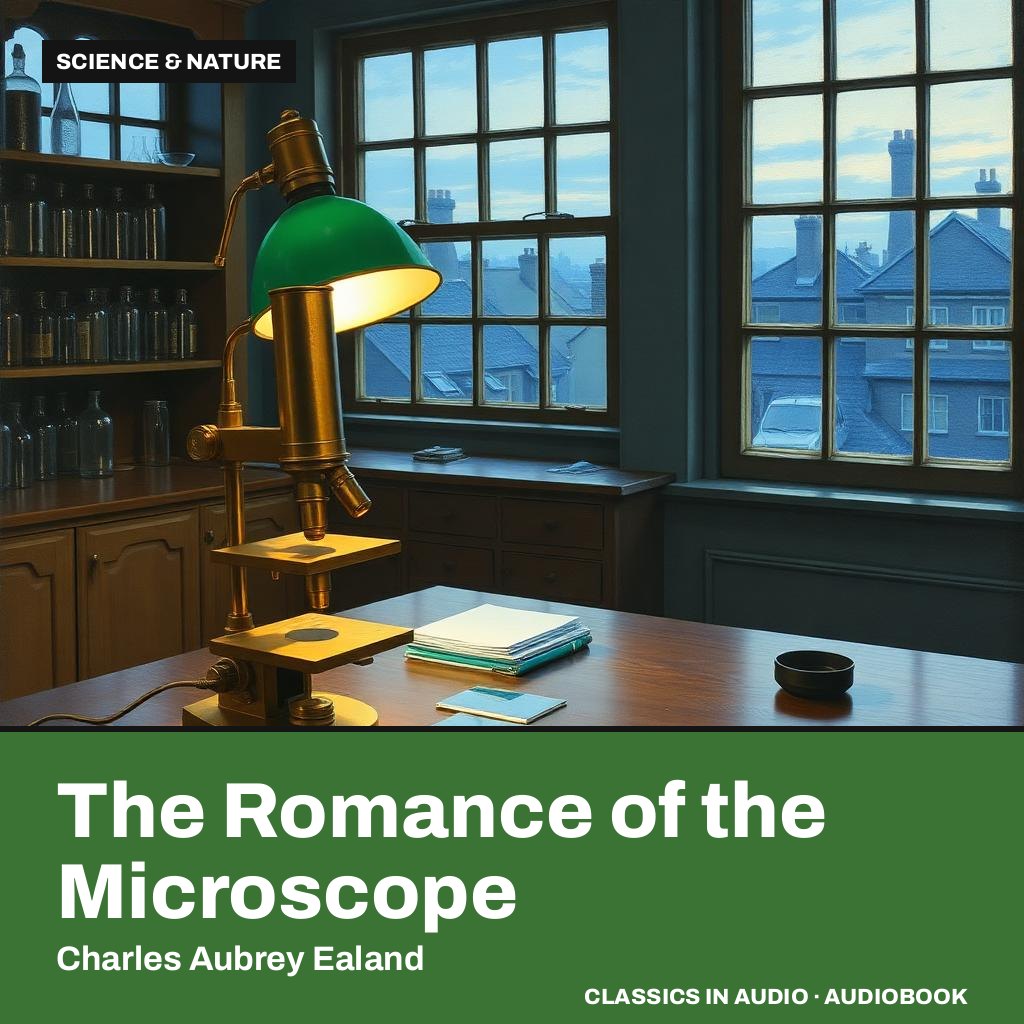
The Romance of the Microscope
An Interesting Description of Its Uses in All Branches of Science, Industry, Agriculture, and in the Detection of Crime, with a Short Account of Its Origin, History, and Development
by Charles Aubrey Ealand (1877–1941)
Unabridged audiobook · about 7 hr 32 min · English · read by a synthetic voice · MP3, no DRM
€4.90
Buy 2 audiobooks or more: −10%. Buy 5 or more: −20%.
Secure payment by Stripe. Your download link is e-mailed to you at once: the first 30 minutes are usually ready within a few minutes, and the rest follows while you listen. Listen online or download the MP3.
Published in London in 1921, this is a popular science book that shows what happens when a lens is turned on the ordinary world. C. A. Ealand, a schoolmaster-turned-writer who also produced books on insects and animal behaviour, sets out to survey the microscope's work in fields that most readers would never connect: the study of living cells, the testing of food and drugs, the inspection of crops and soil, the structure of metals, and the examination of dust, fibres and stains in criminal investigation.
Before the applications, he offers a short history of the instrument itself, tracing how simple magnifying glasses became the compound microscopes used in laboratories and factories. Along the way he describes accessories such as the micro-telescope and the camera attached to the eyepiece, which let observers record what they saw. The book was written for general readers, with 39 illustrations and diagrams, and it explains each technique in plain terms without assuming a scientific background.
Today it reads as a snapshot of early twentieth-century science, a moment when forensic work, industrial testing and public-health research were all being reshaped by what could be seen at high magnification. It is worth hearing for the clarity of its explanations, and for the sense of how much seemed newly visible a century ago.
Text: Project Gutenberg edition no. 49505, read without its licence notices.
More science & nature
 Body-build and Its InheritanceCharles Benedict Davenport7 hr 56 min€4.90
 On the Origin of Species By Means of Natural SelectionCharles Darwin15 hr 22 min€6.90
 The Interpretation of DreamsSigmund Freud20 hr 00 min€6.90
 The Origin of Species by Means of Natural SelectionCharles Darwin20 hr 41 min€7.90
 Novum OrganumFrancis Bacon8 hr 50 min€4.90
 The Magic of Jewels and CharmsGeorge Frederick Kunz13 hr 31 min€5.90