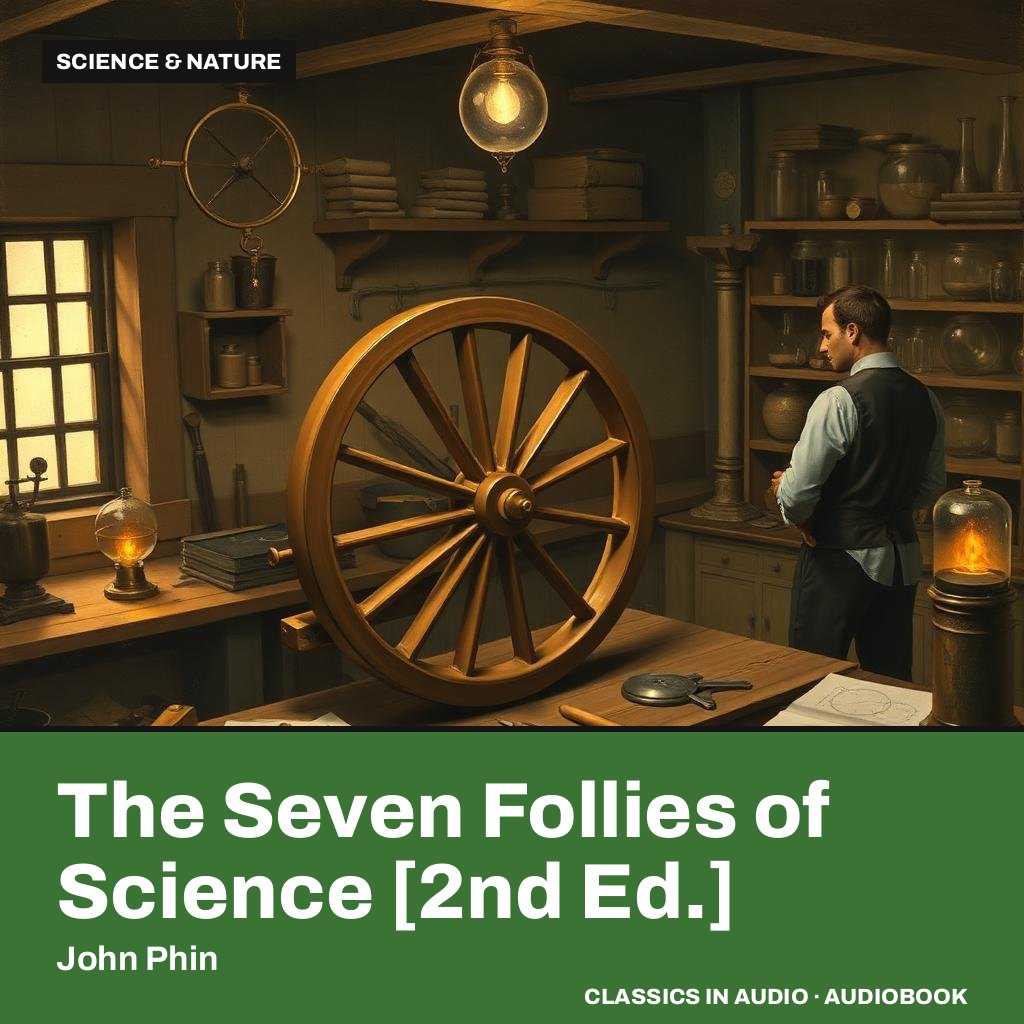
The Seven Follies of Science [2nd Ed.]
A Popular Account of the Most Famous Scientific Impossibilities and the Attempts Which Have Been Made to Solve Them. To Which Is Added a Small Budget of Interesting Paradoxes, Illusions, and Marvels
by John Phin (1830–1913)
Unabridged audiobook · about 4 hr 25 min · English · read by a synthetic voice · MP3, no DRM
€3.90
Buy 2 audiobooks or more: −10%. Buy 5 or more: −20%.
Secure payment by Stripe. Your download link is e-mailed to you at once: the first 30 minutes are usually ready within a few minutes, and the rest follows while you listen. Listen online or download the MP3.
John Phin, an American publisher and writer on practical science and mechanics, wrote this book in 1905 as a plain-spoken tour of the problems that have tempted clever people for centuries and defeated every one of them. Its seven follies are squaring the circle, doubling the cube, trisecting an angle, perpetual motion, turning base metals into gold, fixing quicksilver, and brewing a universal medicine or elixir of life. Phin explains why geometers and tinkerers kept trying, what the attempts actually looked like, and where science finally drew the line between the difficult and the impossible. He keeps formulas out of it, so anyone with simple arithmetic can follow.
A further set of lesser follies follows, among them ever-burning lamps, the universal solvent, and the powder of sympathy, a salve said to heal a wound from a distance.
The last part is a budget of paradoxes, optical illusions, and curiosities. It asks whether a man can lift himself by his bootstraps, how a watch can stand in for a compass, how the whole Bible might be written on a square inch, and what a chessboard doubling puzzle really adds up to. It is a good listen for anyone who likes seeing how mistakes shaped knowledge.
Text: Project Gutenberg edition no. 36547, read without its licence notices.
More science & nature
 Body-build and Its InheritanceCharles Benedict Davenport7 hr 56 min€4.90
 On the Origin of Species By Means of Natural SelectionCharles Darwin15 hr 22 min€6.90
 The Interpretation of DreamsSigmund Freud20 hr 00 min€6.90
 The Origin of Species by Means of Natural SelectionCharles Darwin20 hr 41 min€7.90
 Novum OrganumFrancis Bacon8 hr 50 min€4.90
 The Magic of Jewels and CharmsGeorge Frederick Kunz13 hr 31 min€5.90