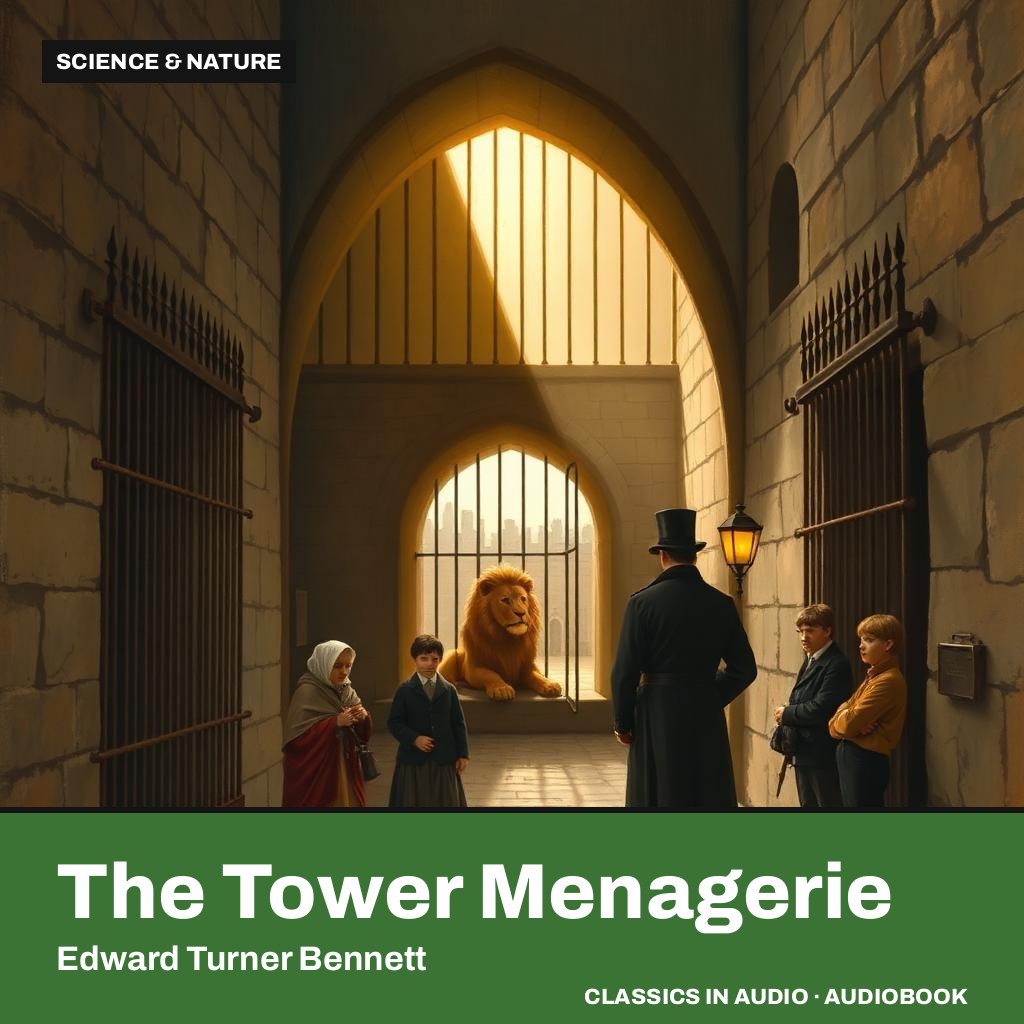
The Tower Menagerie
Comprising the Natural History of the Animals Contained in That Establishment; with Anecdotes of Their Characters and History.
by Edward Turner Bennett (1797–1836)
Unabridged audiobook · about 5 hr 43 min · English · read by a synthetic voice · MP3, no DRM
€4.90
Buy 2 audiobooks or more: −10%. Buy 5 or more: −20%.
Secure payment by Stripe. Your download link is e-mailed to you at once: the first 30 minutes are usually ready within a few minutes, and the rest follows while you listen. Listen online or download the MP3.
In the 1820s and 1830s the Tower of London housed a working zoo, and this book is its printed tour. Edward Turner Bennett, a zoologist and a founder of the Zoological Society of London, goes through the collection animal by animal: wolves and jackals, civets and coatis, the American black bear and the grizzly, macaques and baboons, a kangaroo, a porcupine, an Asiatic elephant, a zebra, a llama, and several kinds of deer and antelope.
The tour continues with golden eagles, vultures, macaws and cockatoos, an emu, a pelican, an alligator, and finally the Indian boa, the anaconda and the rattlesnake. Each entry gives the creature's natural history, where it lives and how it is built, along with anecdotes about the individual animals who paced and perched in the Tower's cages.
Before the animals, Bennett opens with a brisk history of menageries, from the beast-pens of ancient chiefs and temples to Alexander's specimens sent home to Aristotle and the arena-bound captives of Rome. The book shows how early Victorian naturalists observed living animals, how much was already known, and how much was still guesswork. It suits anyone curious about the history of zoology, or about how Londoners once met lions, bears and elephants.
Text: Project Gutenberg edition no. 53764, read without its licence notices.
More science & nature
 Body-build and Its InheritanceCharles Benedict Davenport7 hr 56 min€4.90
 On the Origin of Species By Means of Natural SelectionCharles Darwin15 hr 22 min€6.90
 The Interpretation of DreamsSigmund Freud20 hr 00 min€6.90
 The Origin of Species by Means of Natural SelectionCharles Darwin20 hr 41 min€7.90
 Novum OrganumFrancis Bacon8 hr 50 min€4.90
 The Magic of Jewels and CharmsGeorge Frederick Kunz13 hr 31 min€5.90