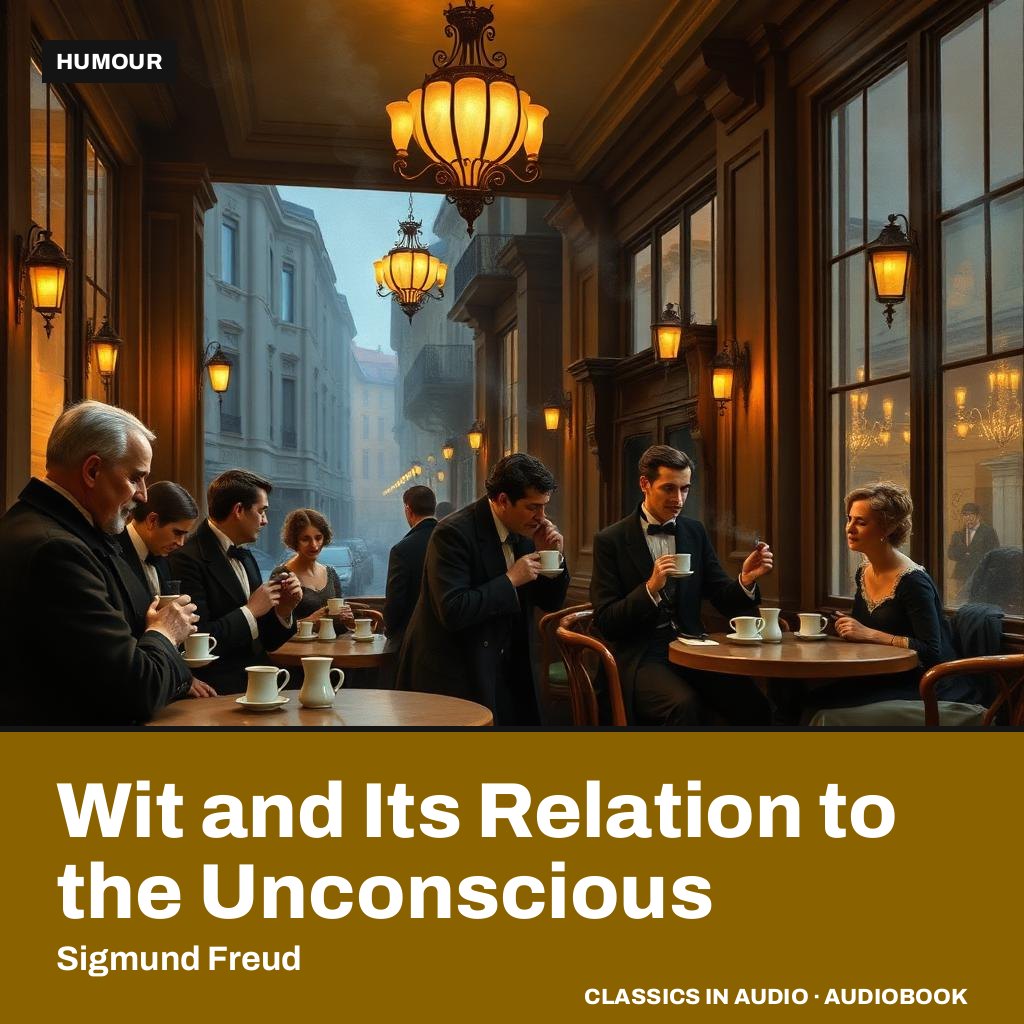
Wit and Its Relation to the Unconscious
by Sigmund Freud (1856–1939)
Unabridged audiobook · about 8 hr 01 min · English · read by a synthetic voice · MP3, no DRM
€4.90
Buy 2 audiobooks or more: −10%. Buy 5 or more: −20%.
Secure payment by Stripe. Your download link is e-mailed to you at once: the first 30 minutes are usually ready within a few minutes, and the rest follows while you listen. Listen online or download the MP3.
In Wit and Its Relation to the Unconscious, Sigmund Freud asks a question that looks almost frivolous: why does a joke make us laugh, and what exactly is going on in the mind when it works? The book, first published in German in 1905, takes jokes seriously as evidence. Freud collects puns, compressed phrases, Jewish anecdotes and sharp remarks from Viennese and German life, then takes them apart to see how they are built.
The argument runs in three stages. He first analyses the techniques of wit, such as condensation, double meaning and allusion. He then looks at its purposes, including the way a joke can slip past an inner censor to express hostility or desire that polite speech would block. Finally he compares wit with dreams and with the comic, claiming that all three draw on the same hidden mental processes. Along the way he reviews earlier thinkers, among them Jean Paul, Kuno Fischer and Theodor Lipps.
Freud, the Viennese founder of psychoanalysis, wrote this soon after The Interpretation of Dreams. This 1916 English version is by A. A. Brill, who replaced untranslatable German jokes with English substitutes. It is worth hearing now as a study of humor and as an early look at how Freud worked.
Text: Project Gutenberg edition no. 75915, read without its licence notices.
More by Sigmund Freud
 The Interpretation of DreamsSigmund Freud20 hr 00 min€6.90
 A General Introduction to PsychoanalysisSigmund Freud15 hr 24 min€6.90
 Three Contributions to the Theory of SexSigmund Freud4 hr 19 min€3.90
 Dream PsychologySigmund Freud5 hr 14 min€4.90
 Totem and TabooSigmund Freud6 hr 02 min€4.90
 Psychopathology of Everyday LifeSigmund Freud6 hr 54 min€4.90
More humour
 The Expedition of Humphry ClinkerTobias Smollett13 hr 55 min€5.90
 CandideVoltaire3 hr 16 min€3.90
 Love and Freindship [sic]Jane Austen3 hr 14 min€3.90
 Northanger AbbeyJane Austen7 hr 05 min€4.90
 A Pickle for the Knowing OnesTimothy Dexter1 hr 23 min€3.90
 The Pickwick PapersCharles Dickens28 hr 38 min€7.90