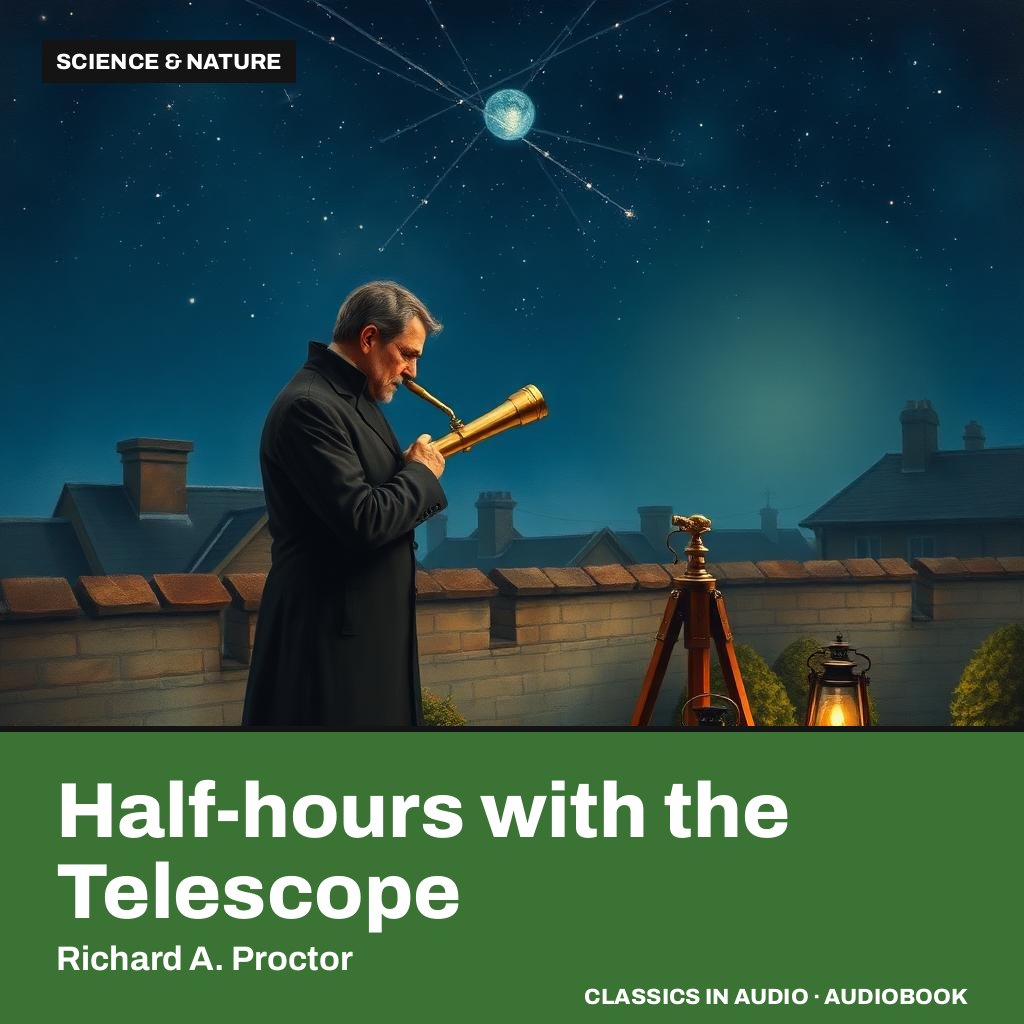
Half-hours with the Telescope
Being a Popular Guide to the Use of the Telescope as a Means of Amusement and Instruction.
by Richard A. Proctor (1837–1888)
Unabridged audiobook · about 3 hr 02 min · English · read by a synthetic voice · MP3, no DRM
€3.90
Buy 2 audiobooks or more: −10%. Buy 5 or more: −20%.
Secure payment by Stripe. Your download link is e-mailed to you at once: the first 30 minutes are usually ready within a few minutes, and the rest follows while you listen. Listen online or download the MP3.
Richard A. Proctor's guide, first issued in 1868, is a practical handbook for the amateur with a small telescope, in particular a good three-inch refractor. It opens with a chapter on how the instrument is built and how to use it, then moves through the sky season by season. Each of four chapters takes a group of constellations, among them Orion, Lyra, Bootes and Andromeda, and points out the double stars, clusters and nebulae worth seeking in them.
The later chapters turn to the planets and then to the Sun and Moon. Proctor pays close attention to what a modest lens will actually show. He warns readers not to expect the crisp detail of the engraved views of Mars, and he explains how to draw star-maps of one's own on a conical projection, so that the sky becomes familiar region by region. His advice on picking out a hard double star is that knowing in advance what to look for is half the work.
Proctor was an English astronomer who wrote and lectured widely for non-specialists, and he drew on the Mars observations of William Dawes for his chart. The book shows how Victorian amateurs learned the heavens with brass tubes, printed charts and patience, and its instructions still work for anyone with a clear night and a small telescope.
Text: Project Gutenberg edition no. 16767, read without its licence notices.
More by Richard A. Proctor
 Myths and Marvels of AstronomyRichard A. Proctor10 hr 38 min€5.90
 Flowers of the SkyRichard A. Proctor5 hr 42 min€4.90
 Rough Ways Made SmoothRichard A. Proctor10 hr 35 min€5.90
More science & nature
 Body-build and Its InheritanceCharles Benedict Davenport7 hr 56 min€4.90
 On the Origin of Species By Means of Natural SelectionCharles Darwin15 hr 22 min€6.90
 The Interpretation of DreamsSigmund Freud20 hr 00 min€6.90
 The Origin of Species by Means of Natural SelectionCharles Darwin20 hr 41 min€7.90
 Novum OrganumFrancis Bacon8 hr 50 min€4.90
 The Magic of Jewels and CharmsGeorge Frederick Kunz13 hr 31 min€5.90