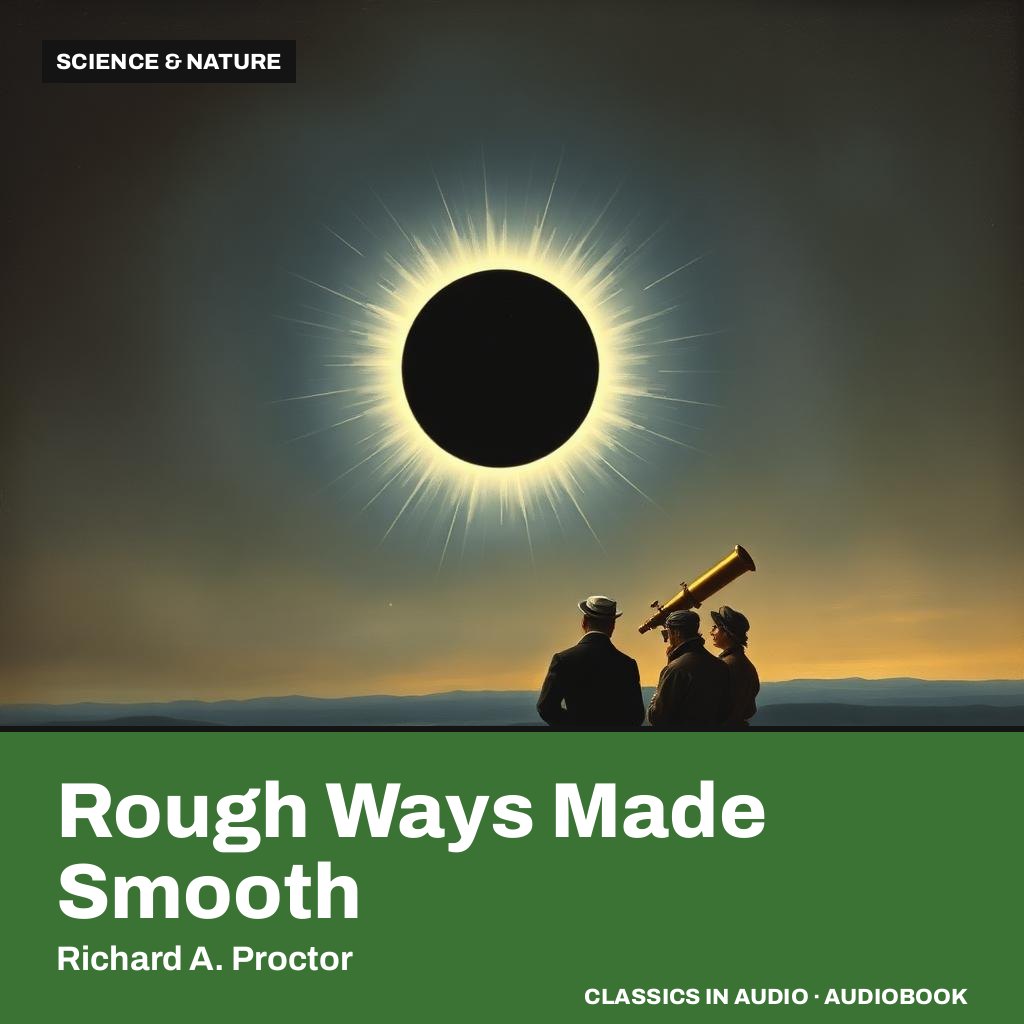
Rough Ways Made Smooth
A Series of Familiar Essays on Scientific Subjects
by Richard A. Proctor (1837–1888)
Unabridged audiobook · about 10 hr 35 min · English · read by a synthetic voice · MP3, no DRM
€5.90
Buy 2 audiobooks or more: −10%. Buy 5 or more: −20%.
Secure payment by Stripe. Your download link is e-mailed to you at once: the first 30 minutes are usually ready within a few minutes, and the rest follows while you listen. Listen online or download the MP3.
Rough Ways Made Smooth is a collection of sixteen essays on science, written in 1879 for readers with no technical training. Richard A. Proctor, an English astronomer who wrote and lectured widely and later settled in the United States, begins with the sun. He asks whether the shape and colour of the corona, the pale halo seen only during a total eclipse, follow the rise and fall of sun-spots. He weighs the eclipses of 1870, 1871 and 1878 against older records, and he warns against building a theory on a single coincidence.
The other essays range widely. Some look at the sky: planets that might circle close to the sun, the British expeditions that watched Venus cross the sun's face, the early history of the Moon, a reported new lunar crater, and November meteor showers. Others turn to cold winters, the rowing of Oxford and Cambridge crews, artificial sleepwalking, inherited traits, illness as a spur to the mind, dual consciousness, and electric lighting.
The book shows Victorian science in the middle of its arguments, when spectroscopes were new and many questions were open. Proctor explains his reasoning step by step and admits what is still unknown, which makes the essays a good way to see how a scientist of the period thought.
Text: Project Gutenberg edition no. 54557, read without its licence notices.
More by Richard A. Proctor
 Myths and Marvels of AstronomyRichard A. Proctor10 hr 38 min€5.90
 Half-hours with the TelescopeRichard A. Proctor3 hr 02 min€3.90
 Flowers of the SkyRichard A. Proctor5 hr 42 min€4.90
More science & nature
 Body-build and Its InheritanceCharles Benedict Davenport7 hr 56 min€4.90
 On the Origin of Species By Means of Natural SelectionCharles Darwin15 hr 22 min€6.90
 The Interpretation of DreamsSigmund Freud20 hr 00 min€6.90
 The Origin of Species by Means of Natural SelectionCharles Darwin20 hr 41 min€7.90
 Novum OrganumFrancis Bacon8 hr 50 min€4.90
 The Magic of Jewels and CharmsGeorge Frederick Kunz13 hr 31 min€5.90