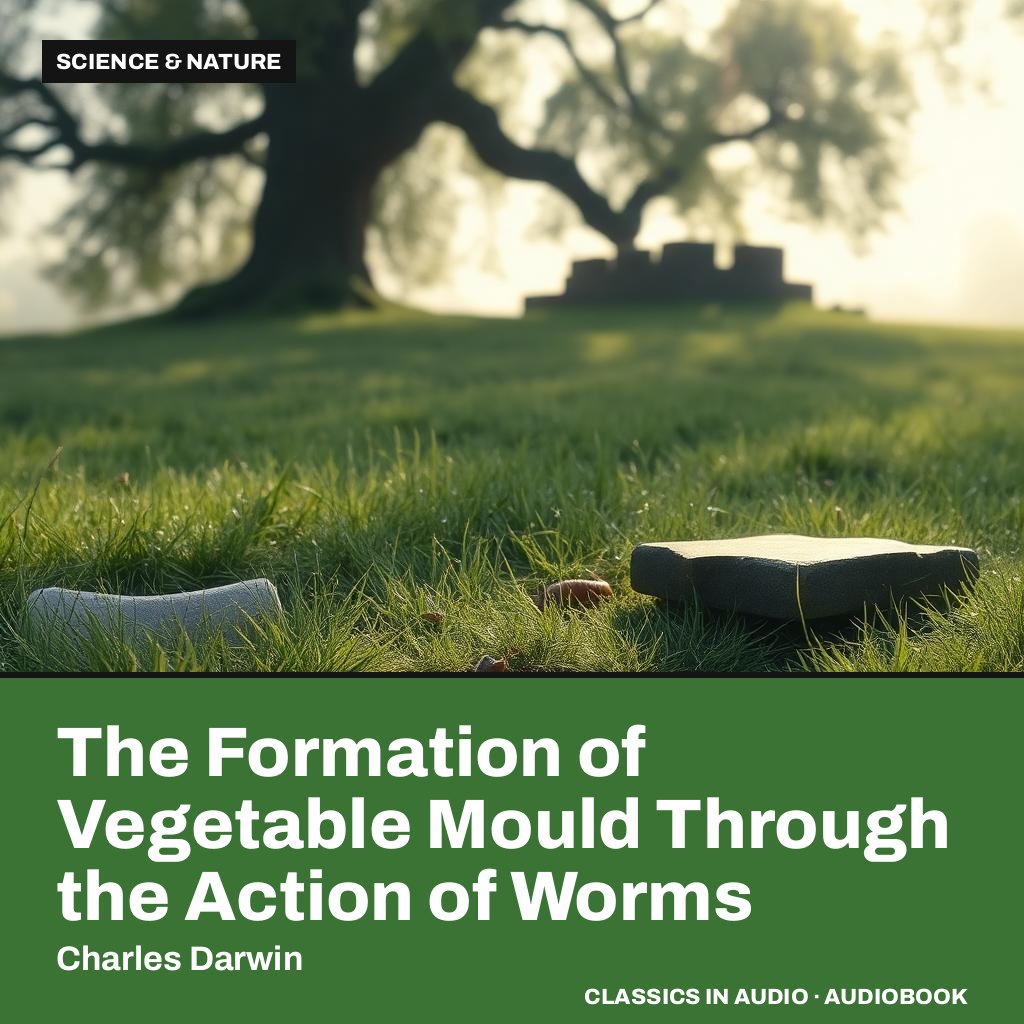
The Formation of Vegetable Mould Through the Action of Worms
With Observations on Their Habits
by Charles Darwin (1809–1882)
Unabridged audiobook · about 5 hr 47 min · English · read by a synthetic voice · MP3, no DRM
€4.90
Buy 2 audiobooks or more: −10%. Buy 5 or more: −20%.
Secure payment by Stripe. Your download link is e-mailed to you at once: the first 30 minutes are usually ready within a few minutes, and the rest follows while you listen. Listen online or download the MP3.
Charles Darwin's last book, published in 1881 a few months before his death, is a study of the humble earthworm and what it does to the ground beneath our feet. It is a work of natural history built on patient observation and experiment, carried out largely in the fields and gardens around his home in Kent.
Darwin asks how the dark, fine-grained layer of vegetable mould that covers moist lands came to be there. His answer is that worms swallow earth and bring it up as castings, year after year. He weighs those castings, counts the worms in a measured plot of grass, and watches stones and scattered chalk slowly sink from sight. He tests how worms plug their burrows with leaves and cut paper triangles, and asks whether such behaviour shows a measure of intelligence. He then follows the same process to Roman villas and abbey pavements in England, buried by the slow work of worms rather than by catastrophe.
The book is dry in places, but it is also surprisingly funny and full of wonder at small things. It shows how gradual causes, given enough time, can reshape a landscape, which is the idea at the heart of Darwin's thinking. It is a good listen for gardeners, archaeology enthusiasts and anyone curious about the soil.
Text: Project Gutenberg edition no. 2355, read without its licence notices.
More by Charles Darwin
 On the Origin of Species By Means of Natural SelectionCharles Darwin15 hr 22 min€6.90
 The Origin of Species by Means of Natural SelectionCharles Darwin20 hr 41 min€7.90
 The Descent of Man, and Selection in Relation to SexCharles Darwin30 hr 23 min€9.90
 The Voyage of the BeagleCharles Darwin19 hr 29 min€6.90
 The Expression of the Emotions in Man and AnimalsCharles Darwin10 hr 35 min€5.90
 The Autobiography of Charles DarwinCharles Darwin2 hr 05 min€3.90
More science & nature
 Body-build and Its InheritanceCharles Benedict Davenport7 hr 56 min€4.90
 The Interpretation of DreamsSigmund Freud20 hr 00 min€6.90
 Novum OrganumFrancis Bacon8 hr 50 min€4.90
 The Magic of Jewels and CharmsGeorge Frederick Kunz13 hr 31 min€5.90
 A General Introduction to PsychoanalysisSigmund Freud15 hr 24 min€6.90
 Three Contributions to the Theory of SexSigmund Freud4 hr 19 min€3.90