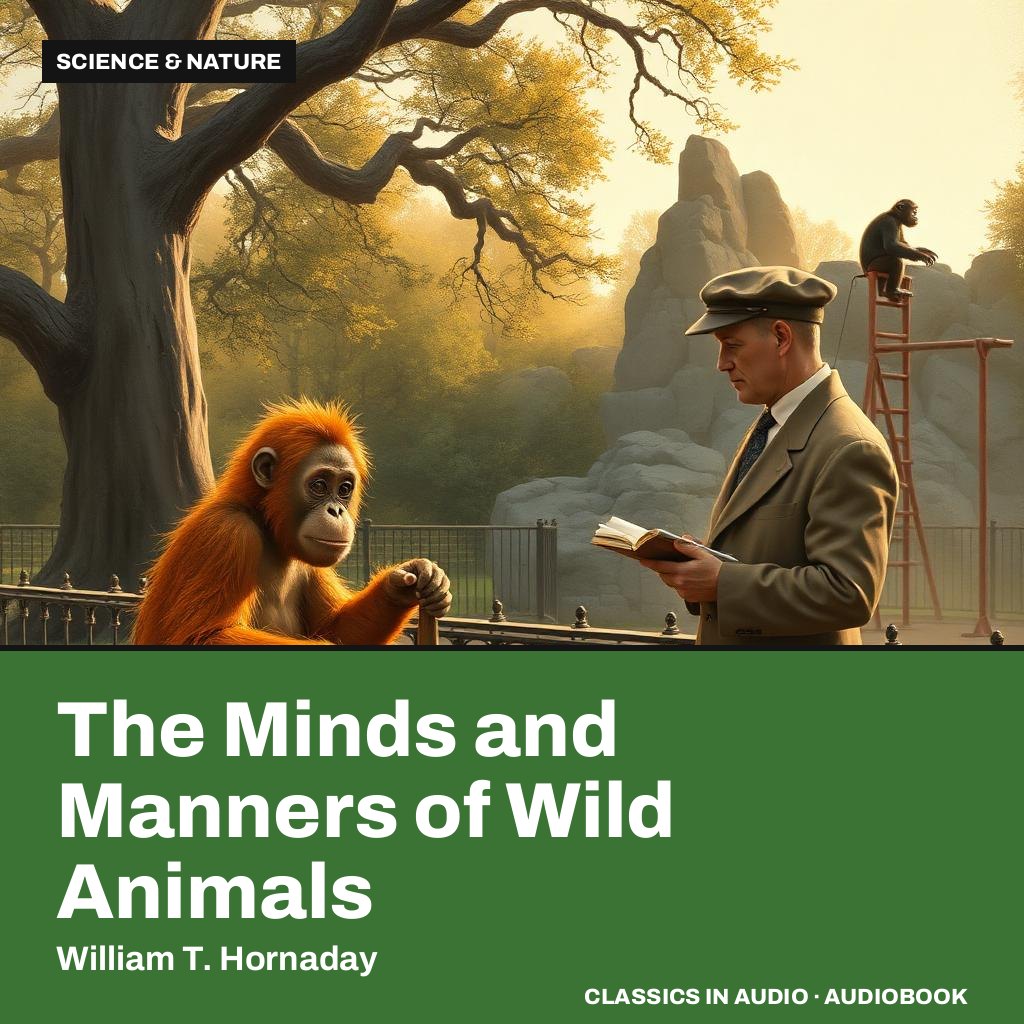
The Minds and Manners of Wild Animals
A Book of Personal Observations
by William T. Hornaday (1854–1937)
Unabridged audiobook · about 9 hr 36 min · English · read by a synthetic voice · MP3, no DRM
€4.90
Buy 2 audiobooks or more: −10%. Buy 5 or more: −20%.
Secure payment by Stripe. Your download link is e-mailed to you at once: the first 30 minutes are usually ready within a few minutes, and the rest follows while you listen. Listen online or download the MP3.
William T. Hornaday spent decades as a hunter, taxidermist, zoo director and conservationist, and in this 1922 volume he sets down what he saw of wild animals at close range. He was the first director of the New York Zoological Park, and he writes mostly from his own observation rather than from quoted authorities. Domestic animals are deliberately left out.
The chapters work like a series of case studies. Some compare the minds of orang-utans, chimpanzees, gorillas, elephants and bears. Others turn to ruminants, rodents, birds and snakes, and to the training of captive animals. Later sections ask harder questions about animal morals, courage, fear, play, the laws of herds and flocks, and even what he calls animal crime. Hornaday gives the facts of each incident and lets the reader weigh the evidence, though he is not shy about his own conclusions.
The book belongs to the years just after the First World War, and its preface says plainly that he found wild creatures a relief from human quarrels. It also carries an urgent plea to study animals rather than shoot them, since many species were vanishing. Listeners today will find both an early field naturalist's curiosity and some views of his era that have since been revised.
Text: Project Gutenberg edition no. 6052, read without its licence notices.
More by William T. Hornaday
 The Extermination of the American BisonWilliam T. Hornaday8 hr 45 min€4.90
 Popular Official Guide to the New York Zoological Park (September 1915)William T. Hornaday5 hr 16 min€4.90
 Taxidermy and Zoological CollectingWilliam T. Hornaday11 hr 48 min€5.90
More science & nature
 Body-build and Its InheritanceCharles Benedict Davenport7 hr 56 min€4.90
 On the Origin of Species By Means of Natural SelectionCharles Darwin15 hr 22 min€6.90
 The Interpretation of DreamsSigmund Freud20 hr 00 min€6.90
 The Origin of Species by Means of Natural SelectionCharles Darwin20 hr 41 min€7.90
 Novum OrganumFrancis Bacon8 hr 50 min€4.90
 The Magic of Jewels and CharmsGeorge Frederick Kunz13 hr 31 min€5.90